
Introduction
Troop deployment Big Bend National Park — why did the U.S. military send hundreds of soldiers to one of America’s most beloved national parks? Millions of people are searching for the full story in 2026. Furthermore, Big Bend National Park — a stunning expanse of desert mountains and river canyons in West Texas — became the center of a major national debate when the Trump administration deployed combat-trained troops and armored Stryker vehicles inside its boundaries as part of a sweeping border security operation. However, the park shares 118 miles of border with Mexico along the Rio Grande, making it a significant point in the administration’s broader immigration crackdown. Moreover, the deployment sparked immediate controversy among environmentalists, national park advocates, and local residents who questioned whether a national park was the right location for a military operation. As a result, the troop deployment Big Bend National Park story has become one of the most widely discussed border security and conservation stories of 2025 and 2026. In this article, we cover everything about the troop deployment Big Bend National Park situation and what it means going forward. So let us get started!
Troop Deployment Big Bend National Park? The Direct Answer
Troop Deployment Big Bend National Park — What Happened
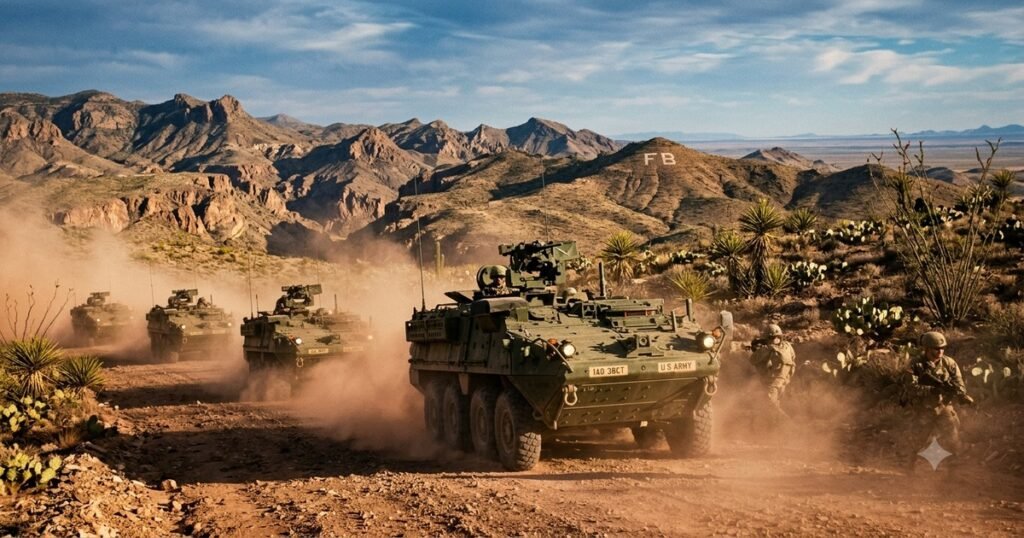
The troop deployment Big Bend National Park operation began on March 13, 2025, when the Trump administration sent the first wave of soldiers to the region. Furthermore, 200 combat-trained soldiers from the Army’s 4th Infantry Division at Fort Carson, Colorado were the first to arrive, with the total number expected to grow to approximately 500 troops in the weeks that followed. Moreover, the troops arrived with Stryker armored combat vehicles — eight-wheeled transports capable of carrying up to 11 troops each and reaching speeds of 60 miles per hour — marking one of the most significant military presences ever seen inside a U.S. national park. As a result, Big Bend National Park transformed overnight from a remote wilderness destination into an active military operational zone along the southern border.
Troop Deployment Big Bend National Park — What The Troops Are Doing
The troop deployment Big Bend National Park mission is specifically focused on border surveillance and support — not direct law enforcement. Furthermore, troops are supporting U.S. Customs and Border Protection with surveillance and intelligence gathering, but are not directly involved in arresting individuals suspected of immigration violations. Moreover, the battalion commander confirmed that troops will not be making immigration arrests, but will instead provide logistics, surveillance technology, and operational support to federal agents already working in the region. As a result, the military deployment functions as a force multiplier for existing border enforcement operations rather than a replacement for civilian law enforcement.
Troop Deployment Big Bend National Park? Why This Location
Troop Deployment Big Bend National Park — The Border Geography
Understanding the troop deployment Big Bend National Park decision requires understanding the park’s unique geography. Furthermore, Big Bend National Park shares 118 miles of border with Mexico along the Rio Grande river — one of the longest stretches of any U.S. national park along the southern border. Moreover, the park also contains the Boquillas Border Crossing, an official port of entry used to process legal border crossings between Texas and the Mexican state of Coahuila. As a result, Big Bend is not simply a remote wilderness area — it is an active border zone that connects the United States and Mexico across a vast and largely unmonitored stretch of rugged terrain.
Troop Deployment Big Bend National Park — Relatively Low Crossing Numbers
The troop deployment Big Bend National Park decision has been challenged by border crossing statistics that suggest the area is not among the busiest enforcement zones on the southern border. Furthermore, in February 2025, Customs and Border Protection reported approximately 165 migrant encounters in the Big Bend sector — compared to 1,679 in Laredo and 2,623 in El Paso during the same period. Moreover, apprehensions of undocumented immigrants across the entire southern border reached their lowest levels in decades during that same month. As a result, critics of the deployment have argued that sending 500 troops and armored vehicles to one of the quieter stretches of the border represents a disproportionate use of military resources.
Here is a quick overview of the troop deployment Big Bend National Park key facts:
| Detail | Information |
|---|---|
| Deployment start date | March 13, 2025 |
| First wave | 200 soldiers from Army’s 4th Infantry Division, Fort Carson, Colorado |
| Planned total | Approximately 500 troops |
| Equipment | Eight-wheeled Stryker armored combat vehicles |
| Park border length | 118 miles along the Rio Grande with Mexico |
| Mission | Border surveillance and intelligence support — no arrest authority |
| Big Bend migrant encounters (Feb 2025) | Approximately 165 — among the lowest on the southern border |
| Annual park visitors | Over 500,000 — up 50 percent since 2016 |
| Park status | Open to visitors throughout the deployment |
Furthermore, this overview captures every key fact about the deployment in one place. As a result, readers can quickly understand the scale, scope, and context of the military presence inside one of America’s most visited national parks.
Troop Deployment Big Bend National Park? The Environmental Concerns
Troop Deployment Big Bend National Park — Are The Troops Bound By Park Rules
One of the most pressing questions raised by the troop deployment Big Bend National Park situation is whether military personnel operating inside the park are subject to the same environmental laws that govern all other activities there. Furthermore, national park advocates raised immediate concerns about whether the troops’ movements would be governed by any agreement or memorandum of understanding and whether they would be bound by federal environmental laws such as the National Environmental Protection Act or the Endangered Species Act. Moreover, a U.S. Army spokesman initially told reporters that there was no necessity to have a formal agreement with the National Park Service clearly stating guidelines around the Army’s actions inside the park — a statement that alarmed conservation advocates. As a result, park officials stepped in to confirm cooperation with military planners to ensure minimal impacts to the park and its visitors.
Troop Deployment Big Bend National Park — The Sierra Club Response
The troop deployment Big Bend National Park operation drew sharp criticism from one of America’s most prominent environmental organizations. Furthermore, the Sierra Club condemned the deployment as a waste of taxpayer money — arguing that sending hundreds of combat soldiers and armored vehicles to one of the least active border sectors made no logical case as a border security measure. Moreover, conservation advocates warned that Stryker vehicles and heavy military equipment moving through sensitive desert ecosystems could cause lasting damage to protected habitats, endangered species corridors, and fragile desert terrain that the National Park Service has spent decades carefully preserving. As a result, the environmental community’s opposition to the deployment became one of the most persistent voices of criticism throughout 2025 and into 2026.
Troop Deployment Big Bend National Park? What It Means For Visitors
Troop Deployment Big Bend National Park — The Park Is Still Open
Despite the military presence, the troop deployment Big Bend National Park operation has not closed the park to visitors. Furthermore, park officials confirmed that visitors are still welcome to explore the park and that no impacts to park operations or visitor services were anticipated at the time of the initial deployment. Moreover, all three visitor centers remained open, and major tourist attractions including the Chisos Mountains and Santa Elena Canyon continued to be accessible to the public throughout the deployment. As a result, the roughly 500,000 annual visitors who travel to Big Bend each year — a number that has grown by 50 percent since 2016 — can still experience the park’s remarkable landscapes.
Troop Deployment Big Bend National Park — What Visitors Might See
Visitors to Big Bend during the troop deployment period should be prepared for a noticeably different experience in certain areas of the park. Furthermore, military vehicles including Stryker armored transports may be visible on park roads, particularly in areas near the Rio Grande and the southern border zone. Moreover, some remote areas near the border have restricted access for safety reasons during active military operations, though the main tourist areas and trails remain open. As a result, visitors are advised to check with the National Park Service before planning backcountry trips near the river border areas, as access conditions can change based on operational activity.
Troop Deployment Big Bend National Park? What Comes Next
Troop Deployment Big Bend National Park — Proposed Legislation
The troop deployment Big Bend National Park situation has also triggered legislative activity in Washington. Furthermore, a House subcommittee is considering legislation that would give Border Patrol unfettered access across official and potential wilderness in Big Bend and Organ Pipe Cactus National Monument — a proposal that national park advocates say would fundamentally change the nature of protected wilderness areas along the southern border. Moreover, the legislation would remove certain procedural barriers that currently require environmental review before large-scale operations are conducted in protected lands. As a result, the outcome of this legislative proposal could have lasting consequences not just for Big Bend but for the entire system of national parks and wilderness areas along the U.S.-Mexico border.
Troop Deployment Big Bend National Park — The Bigger Picture
The troop deployment Big Bend National Park decision is part of a much larger military buildup along the entire southern border that began shortly after Trump’s second inauguration. Furthermore, this deployment followed a previous wave of military personnel already sent to other parts of the border, and under a separate agreement between Texas and the Trump administration, some National Guard soldiers have been deputized to carry out immigration arrests — a significant expansion of the military’s traditional support role in domestic law enforcement. Moreover, the Big Bend deployment specifically became the most symbolically powerful moment in that broader buildup because it placed combat troops and armored vehicles inside one of America’s most iconic and protected natural spaces. As a result, the story is simultaneously a border security story, an environmental story, a constitutional story, and a story about what America’s national parks are for.
Frequently Asked Questions (FAQs)
Q1: Why were troops deployed to Big Bend National Park? The Trump administration deployed troops to Big Bend National Park as part of a broader border security crackdown, since the park shares 118 miles of border with Mexico along the Rio Grande. Furthermore, troops from the Army’s 4th Infantry Division were sent to support U.S. Customs and Border Protection with surveillance and intelligence operations. As a result, the deployment was framed as a border enforcement measure rather than a national park management decision.
Q2: How many troops were deployed to Big Bend National Park? The initial deployment began with approximately 200 soldiers from the Army’s 4th Infantry Division at Fort Carson, Colorado, with the total expected to grow to approximately 500 troops. Furthermore, the soldiers arrived with Stryker armored combat vehicles capable of carrying up to 11 troops each. As a result, Big Bend saw one of the most significant military presences ever deployed inside a U.S. national park.
Q3: Can troops arrest people inside Big Bend National Park? No. The battalion commander confirmed that troops deployed to Big Bend will not be making immigration arrests. Furthermore, their role is limited to providing surveillance, intelligence support, and logistical assistance to U.S. Customs and Border Protection agents. As a result, direct arrest authority remains with civilian law enforcement agencies rather than military personnel.
Q4: Is Big Bend National Park still open to visitors? Yes. Park officials confirmed that Big Bend National Park remains open to visitors throughout the military deployment. Furthermore, all three visitor centers stayed open and major attractions including the Chisos Mountains and Santa Elena Canyon remain accessible. As a result, visitors can still experience the park — though military vehicles and personnel may be visible in certain areas, particularly near the southern border zone.
Q5: Why did the Sierra Club criticize the Big Bend deployment? The Sierra Club called the deployment a waste of taxpayer money, arguing that Big Bend is one of the least active border crossings on the southern border. Furthermore, environmental advocates warned that heavy military vehicles moving through sensitive desert ecosystems could cause lasting damage to protected habitats and endangered species. As a result, the environmental community has consistently opposed the deployment on both practical and conservation grounds.
Q6: How many people visit Big Bend National Park each year? Big Bend National Park receives over 500,000 visitors per year — a number that has grown by 50 percent since 2016. Furthermore, it is the most visited national park in Texas. As a result, the military deployment affects one of the most popular outdoor destinations in the entire southwestern United States.
Conclusion
So what is the full story of the troop deployment Big Bend National Park situation? The answer is clear. The Trump administration deployed approximately 200 to 500 combat-trained soldiers from the Army’s 4th Infantry Division — along with Stryker armored vehicles — to Big Bend National Park in West Texas beginning March 13, 2025, as part of a broader immigration enforcement operation along the southern border. Furthermore, the deployment triggered immediate controversy from environmental groups, national park advocates, and local residents who questioned both the military necessity of sending troops to one of the quietest border sectors and the potential environmental damage that heavy military equipment could cause inside a protected national park. Moreover, the park itself has remained open to its more than 500,000 annual visitors throughout the deployment, though some areas near the border have restricted access. As a result, the troop deployment Big Bend National Park story remains one of the most symbolically powerful flashpoints in the ongoing national debate over immigration enforcement, environmental protection, and the future of America’s national parks in 2026.
Stay tuned to WorldForbes for the latest updates on border security, national park news, and U.S. policy developments in 2026.
Pingback: What Are the Most Reliable News Sources in 2026? Complete Guide - WorldForbes