
Introduction
Indianapolis flooding 2026 — why are residents navigating their neighborhoods in kayaks and rowboats right now? Millions of people across the Midwest are searching for the latest updates on one of the most severe natural disasters to hit Indiana in a generation. Furthermore, a relentless week of thunderstorms has brought catastrophic flooding across central Indiana — with the White River rising to its highest levels in more than 30 years, swallowing streets, surrounding homes, and overwhelming emergency services across Indianapolis and surrounding communities. However, as of Saturday, August 15, 2026, the crisis is still unfolding — with more heavy rainfall expected through the weekend, at least six people dead, 95 residents rescued by boat, and more than 150,000 households without power. Moreover, President Donald Trump approved a Presidential Emergency Declaration for Indiana following a Saturday afternoon call with Governor Mike Braun — unlocking up to $5 million in federal funds for the state’s emergency response. As a result, the Indianapolis flooding 2026 is now an officially declared federal emergency — and the situation is still changing by the hour. In this article, we cover everything about the Indianapolis flooding 2026 and exactly what you need to know right now. So let us get started!
Indianapolis Flooding 2026? The Direct Answer
Indianapolis Flooding 2026 — How Bad Is It
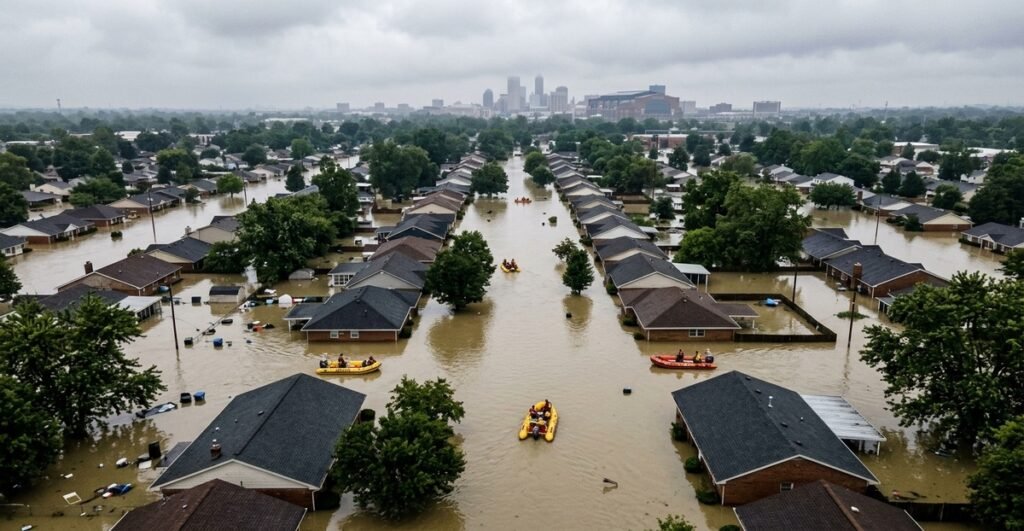
The Indianapolis flooding 2026 is the worst flood the city has experienced in over three decades. Furthermore, Marion County Emergency Management Director Jacob Spence told the Associated Press directly: “This is one of those once-in-a-lifetime type floods.” Moreover, the White River — which runs through the heart of Indianapolis — reached peak flooding levels on the north side of the city on Saturday evening, with the river cresting at approximately 20 feet — a level that submerged streets, surrounded homes, and required dozens of water rescues across the city’s most flood-prone neighborhoods. As a result, communities including Broad Ripple, Ravenswood, and Rocky Ripple bore the worst of the flooding — with drone footage captured by NBC News showing murky floodwaters swallowing streets and rising to front doors as residents navigated their neighborhoods by kayak and rowboat.
Indianapolis Flooding 2026 — The Death Toll and Rescues
The Indianapolis flooding 2026 has claimed at least six lives across Indiana. Furthermore, Governor Mike Braun confirmed Saturday that at least six people have died in the powerful storm system — saying “my heart is with the families and loved ones of the five Hoosiers we have lost and every family whose life has been changed by these storms.” Moreover, the Indianapolis Fire Department conducted at least 51 water rescues as of Saturday evening — evacuating approximately 95 residents and 45 pets from flood-affected areas. As a result, the human toll of the Indianapolis flooding 2026 is still climbing as emergency crews continue to reach neighborhoods that floodwaters have not yet fully receded from.
Indianapolis Flooding 2026? Which Neighborhoods Were Hit Hardest
Indianapolis Flooding 2026 — Ravenswood
The Indianapolis flooding 2026 hit Ravenswood — a neighborhood near Keystone Avenue and 71st Street — with particular severity. Furthermore, Marion County officials announced at a Sunday press conference that Ravenswood remains unsafe to return to as of August 17 — making it the last major Indianapolis neighborhood still under evacuation orders as floodwaters recede elsewhere. Moreover, drone footage of Ravenswood showed cars completely submerged and floodwaters reaching the front doors and windows of residential homes — some of which sustained significant structural damage from the sustained water pressure. As a result, Ravenswood residents face an extended displacement that may last days or weeks longer than other affected neighborhoods.
Indianapolis Flooding 2026 — Broad Ripple
The Indianapolis flooding 2026 also devastated the Broad Ripple neighborhood — one of Indianapolis’s most beloved commercial and residential areas near the White River. Furthermore, Indianapolis officials urged residents in flood-prone areas including Broad Ripple to evacuate Friday afternoon as the White River began its rapid rise. Moreover, by Sunday, officials were able to open the flood gates in Broad Ripple and announced that residents could begin returning to their homes if water levels were low — making it one of the first major flood zones to begin recovery. As a result, Broad Ripple’s recovery timeline is faster than Ravenswood’s — but residents returning home face the difficult process of assessing water damage, cleaning out flooded properties, and navigating insurance claims.
Indianapolis Flooding 2026 — Rocky Ripple
The Indianapolis flooding 2026 put the small town of Rocky Ripple — which sits directly on the White River near 56th Street — in an extraordinary and dramatic situation. Furthermore, Rocky Ripple officials posted an urgent call for volunteers on Saturday evening, saying: “We are holding our own. The water is coming over the levee just barely in places and the leaks are getting covered. We are now calling for any help to build sandbags at Hohlt Park. Bring a shovel. Come in 53rd Street.” Moreover, dozens of community volunteers responded to the call — working through the night to reinforce the levee and hold back the surging White River. As a result, Rocky Ripple’s community-led response to the Indianapolis flooding 2026 became one of the most widely shared and emotionally resonant moments of the entire disaster.
Here is a quick overview of the Indianapolis flooding 2026 key facts:
| Detail | Information |
|---|---|
| Flood event start | August 8–9, 2026 — relentless thunderstorms begin |
| White River crest | Approximately 20 feet — highest in 30+ years |
| Deaths confirmed | At least 6 as of August 15, 2026 |
| Water rescues conducted | 51 rescues — 95 residents, 45 pets evacuated |
| Power outages | 150,000+ customers without power at peak |
| Rainfall total | More than 11 inches in some areas over one week |
| Hardest-hit neighborhoods | Ravenswood, Broad Ripple, Rocky Ripple |
| Emergency declaration | Mayor Hogsett — local disaster emergency, Friday Aug 14 |
| Presidential declaration | Trump approved — call with Gov. Braun, Saturday Aug 15 |
| Federal funds unlocked | Up to $5 million via Presidential Emergency Declaration |
| Shelter location | Red Cross — Washington Township Schools Services Center, 8401 Westfield Blvd |
| Text alerts | Text INDYFLOOD26 to 67283 for real-time city updates |
Furthermore, this overview gives residents and concerned family members every key fact about the Indianapolis flooding 2026 in one place. As a result, anyone with loved ones in the affected areas can quickly assess the current situation using this guide.
Indianapolis Flooding 2026? The Federal Emergency Declaration
Indianapolis Flooding 2026 — Trump Approves Emergency Declaration
The Indianapolis flooding 2026 disaster prompted one of the fastest federal emergency responses of the year. Furthermore, Governor Mike Braun spoke directly with President Donald Trump on Saturday afternoon — and Trump approved a Presidential Emergency Declaration for Indiana within hours of that call. Moreover, the declaration unlocks up to $5 million in immediate federal funds to support Indiana’s emergency response — covering costs including search and rescue operations, temporary shelter, and emergency protective measures. As a result, the Presidential Emergency Declaration signals that the federal government recognizes the Indianapolis flooding 2026 as a disaster of sufficient magnitude to require federal support beyond what the state can provide on its own.
Indianapolis Flooding 2026 — Indiana Seeks FEMA Help
The Indianapolis flooding 2026 is also triggering a broader federal assistance request from the state of Indiana. Furthermore, flash flood and flood warnings remained in effect across central Illinois and central Indiana as of Saturday, with flood watches extending from Iowa and Missouri eastward to central West Virginia. Moreover, Indiana is seeking FEMA disaster assistance to help cover the long-term recovery costs — including home repair grants, temporary housing assistance, and public infrastructure repair — that will extend well beyond the immediate emergency response period. As a result, the full federal financial response to the Indianapolis flooding 2026 is expected to far exceed the initial $5 million unlocked by the Presidential Emergency Declaration.
Indianapolis Flooding 2026? What Comes Next
Indianapolis Flooding 2026 — More Rain On The Way
The Indianapolis flooding 2026 crisis is not over — and may get worse before it gets better. Furthermore, the National Weather Service warned Saturday that widespread storms are expected to continue through the Ohio Valley, Midwest, and central Appalachians through at least Sunday — bringing additional precipitation to areas that had just started to see floodwater recede. Moreover, a longtime resident of the Sunshine Gardens neighborhood — James Duvall, an evangelist who has lived there for over 40 years — told reporters standing on the banks of the White River on Saturday: “I’ve never seen the water this high.” As a result, emergency managers are warning residents not to assume the worst is over — and are urging continued vigilance and compliance with evacuation orders through the weekend.
Indianapolis Flooding 2026 — What Residents Should Do Right Now
The Indianapolis flooding 2026 emergency requires specific immediate actions from affected and potentially affected residents. Furthermore, city officials are urging all residents to follow the critical flood safety rule: do not attempt to cross any flooded roadway under any circumstances — three inches of moving water can sweep a person off their feet, six inches can stall any vehicle, and eight inches of water can wipe a vehicle completely off a road. Moreover, residents needing shelter should go to the Red Cross-staffed shelter at Washington Township Schools Services Center at 8401 Westfield Boulevard — and those with pets can go to the Noble Center shelter at 2406 North Tibbs Avenue. As a result, residents can also text INDYFLOOD26 to 67283 to receive real-time flood updates directly from the city of Indianapolis.
Frequently Asked Questions (FAQs)
Q1: How bad is the Indianapolis flooding in 2026? The Indianapolis flooding 2026 is the worst flood the city has experienced in over 30 years, according to Marion County Emergency Management Director Jacob Spence, who called it “one of those once-in-a-lifetime type floods.” Furthermore, the White River crested at approximately 20 feet — its highest level in over three decades. As a result, entire neighborhoods including Ravenswood, Broad Ripple, and Rocky Ripple were severely inundated.
Q2: How many people have died in the Indiana flooding? At least six people have died in the powerful storm system that caused the Indianapolis flooding 2026, according to Governor Mike Braun. Furthermore, the death toll is expected to rise as emergency crews access more affected areas. As a result, Indiana is experiencing one of its deadliest weather events in recent years.
Q3: Did Trump declare an emergency for Indiana? Yes. President Trump approved a Presidential Emergency Declaration for Indiana following a Saturday afternoon call with Governor Mike Braun. Furthermore, the declaration unlocks up to $5 million in immediate federal funds for Indiana’s emergency response. As a result, federal resources are now actively supporting the state’s flood response operations.
Q4: Which Indianapolis neighborhoods are still under evacuation orders? As of Sunday, August 17, Ravenswood remains unsafe to return to. Furthermore, Broad Ripple residents were cleared to return if water levels are low, and Rocky Ripple held its levee with volunteer help. As a result, Ravenswood is the last major Indianapolis neighborhood still under active evacuation orders as of the latest update.
Q5: Where can flood victims get help in Indianapolis? Residents needing shelter can go to the Red Cross shelter at Washington Township Schools Services Center, 8401 Westfield Boulevard. Furthermore, residents with pets can go to the Noble Center shelter at 2406 North Tibbs Avenue. As a result, text INDYFLOOD26 to 67283 for real-time flood updates from the city of Indianapolis.
Q6: Is more rain expected in Indianapolis this weekend? Yes. The National Weather Service warned that widespread storms are expected to continue through the Ohio Valley and Midwest through at least Sunday, bringing additional rain to already saturated areas. Furthermore, emergency managers are urging residents not to assume the worst is over. As a result, continued vigilance and compliance with evacuation orders are essential through the weekend.
Conclusion
So what is the full picture of the Indianapolis flooding 2026 as of August 15, 2026? The answer is that Indianapolis and central Indiana are in the middle of their worst flood in over 30 years — and the crisis is still actively unfolding. Furthermore, the White River crested at approximately 20 feet — its highest level in three decades — killing at least six people, prompting 51 water rescues of 95 residents and 45 pets, knocking out power to over 150,000 households, and forcing evacuations across Ravenswood, Broad Ripple, Rocky Ripple, and other neighborhoods across Marion County. Moreover, President Trump approved a Presidential Emergency Declaration for Indiana on Saturday — unlocking $5 million in immediate federal aid — and more rainfall is expected through the weekend across an already saturated region. As a result, the Indianapolis flooding 2026 is a rapidly evolving emergency that every resident of central Indiana and surrounding states must take seriously — with evacuation orders, flood safety rules, and real-time city alerts providing the most important guidance available right now.
Stay tuned to WorldForbes for the latest updates on the Indianapolis flooding 2026, Indiana emergency news, and Midwest weather developments as they happen.