
First Time on Broadway: How Broadway Shows Work, Tickets and What to Expect
Seeing a Broadway show for the first time is one of those New York experiences people plan whole trips around — and it can also feel confusing before you even buy a ticket. What exactly counts as “Broadway”? Where do you buy tickets safely? How much should you expect to pay, and what happens when you actually get to the theatre?
This guide answers those questions in plain language: what Broadway is, how tickets work, the cheapest legitimate ways to get in, and what to expect on the night.
What “Broadway” actually means
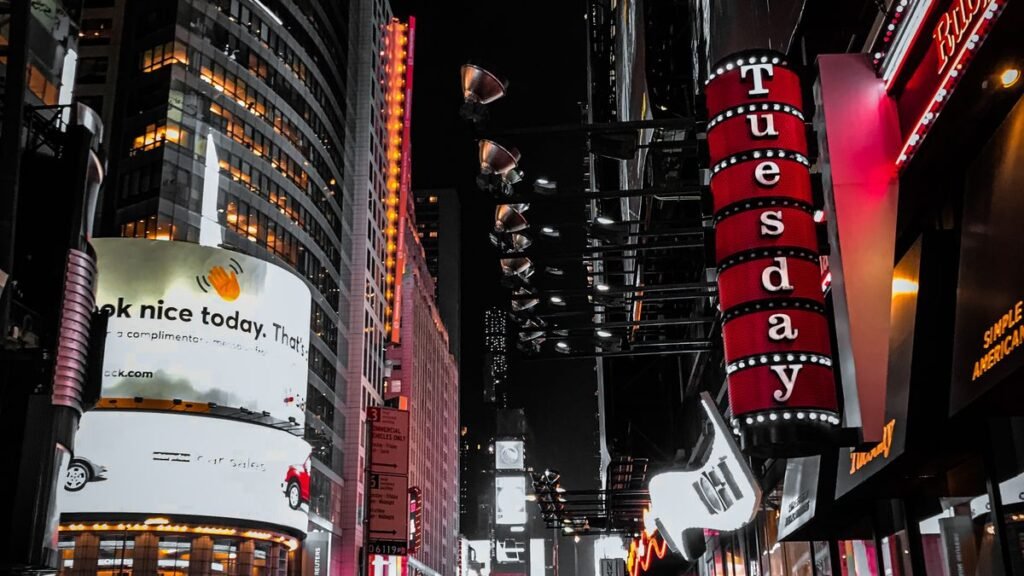
Broadway is not a style of show, and it is not just any big musical in New York. The term refers to a specific group of professional theatres in Manhattan. According to Playbill’s ticket-buying guide, there are currently 41 professional venues in New York City designated as Broadway theatres by the trade group The Broadway League. Most of them sit in the Theatre District around Times Square, roughly between West 41st and West 54th Streets.
The usual definition is a theatre with 500 or more seats in that district. Smaller professional theatres in New York are called Off-Broadway, and they can be just as good — but a “Broadway show” specifically means a production in one of those 41 larger houses.
Broadway runs all year round, with more than 30 shows typically playing at the same time. A hit musical on a Saturday night will cost more and sell out faster than a long-running play on a Tuesday.
How a Broadway week works
Most Broadway productions run eight performances a week, typically Tuesday through Sunday, with matinees (afternoon shows) on Wednesday and Saturday, and sometimes on Thursday or Sunday instead. Monday is the usual dark day, when most theatres are closed — though a few shows do perform on Mondays, so always check the schedule for the specific show you want.
Evening shows usually start at 7 p.m. or 8 p.m., and matinees at 2 p.m. or 3 p.m., but check the show’s official site for the exact curtain time: many theatres hold latecomers in the lobby until a suitable break, and some do not admit them until the interval.
Most musicals run about two to two and a half hours including an interval (called intermission in the US). The running time is always listed on the show’s official page — check it before booking.
How to buy tickets safely
The single most important rule for a first-timer is this: buy from the show’s official ticket seller. Playbill’s guide puts it plainly — the only way to be sure you are buying valid tickets is to buy from the official ticket vendor, either at the show’s box office or through the seller linked from the show’s official website.
Each show’s official website links to its authorised seller, usually Ticketmaster, Telecharge or SeatGeek. Buying this way means you pay the lowest service fees, see the most complete choice of seats, and are told first if a performance is cancelled.
Resale sites are not automatically fake, but they often carry large mark-ups and extra fees. If you search for a show online, resale sites often appear at the top of the results, ahead of the official seller. Go to the show’s own website first and follow its ticket link.
A few practical points about buying:
- Book early for popular shows. The best seats for hit shows and weekend performances sell first. If your dates are fixed, buy as soon as you are ready.
- Check the total price, not just the ticket price. Fees are added on top of the ticket price, and they vary by seller. Add every fee before you compare two options.
- Look at the seat map. Some seats are marked as partial view, which means a pillar or the angle of the stage may block part of what you see.
- A show that looks sold out may not be. Unsold house seats are often released one, two or three days before the performance, and a show is not officially sold out until about five minutes before curtain.
Cheaper ways to see a show
Broadway tickets are not cheap, but there are legitimate ways to pay less. Prices change with demand, and a standard ticket can range roughly from around $50 to $200, with premium seats for the biggest hits costing considerably more. These are the main discount routes:
TKTS discount booths
TKTS is the classic same-day discount option, run by the non-profit Theatre Development Fund (TDF) since 1973. The booths sell same-day performances, and next-day matinees, at 20%, 30%, 40% or 50% off the full price, with each show setting its own discount each day. A service charge of $8 per ticket is included in the price shown.
The main booth is in Times Square, under the red steps at Broadway and West 47th Street. A second booth operates at Lincoln Center — although one November 2026 report said it was closed, so check TDF’s TKTS page before you travel. You buy in person at a booth window; the TKTS app shows what is available, but you cannot buy through it. The choice changes daily and is not announced in advance.
Lotteries and rush tickets
Many shows run digital lotteries: you enter online or through an app, usually a day or two before the performance, and if you win you can buy a heavily discounted ticket. Lotteries run through Broadway Direct, Lucky Seat, Rush.Telecharge and TodayTix, depending on the show. Entering costs nothing, and you are not committed until you pay if you win.
Rush tickets are day-of tickets sold at a steep discount — often around $35 or $40 — at the theatre’s box office, usually from when the box office opens in the morning. Some shows now offer rush tickets through the TodayTix app instead. The rules, prices and times differ from show to show, so read them on the production’s official website.
NYC Broadway Week
Twice a year, the city’s tourism organisation runs NYC Broadway Week, offering two-for-one tickets on participating shows, usually in late January to mid-February and again in late August to early September. For the 2026 winter edition, two-for-one tickets were valid for performances from 20 January to 12 February 2026, with booking opening on 7 January. Check NYC Tourism + Conventions for the exact dates each year.
What to expect on the night
There is no strict dress code on Broadway. Most people wear smart-casual clothes — what they would wear to a nice dinner out. Wear something comfortable, because you will be sitting for two hours or more.
Arrive at least 30 minutes before curtain, so you have time to find your seat and settle in without rushing.
A few things to know once you are inside:
- Phones off. Switch your phone to silent, or off, before the show starts. Taking photos or recording video during the performance is not allowed, and ushers will stop you.
- The interval. Most shows have one interval of about 15 to 20 minutes. The toilet queues are long, so go promptly.
- Late seating. If you arrive after curtain, you may have to wait in the lobby until a suitable moment, so as not to disturb the audience and the performers.
The bottom line
Broadway is simpler than it looks. Pick a show you will enjoy, buy from the official seller linked on the show’s own website, and if your budget is tight, try TKTS, a lottery or rush tickets. Arrive early, switch your phone off, and enjoy the show.
Related reading on WorldForbes
- How to Check a Viral News Claim Before You Share It — the same checking habit helps here: verify a ticket seller before you pay, just as you would verify a news claim before you share it.
- Is ChatGPT Free? What the Free Tier Includes in 2026 — another WorldForbes explainer that separates what is genuinely free from what only looks free, which is a useful instinct when comparing ticket prices and fees.
Frequently asked questions
What does “Broadway” mean?
It refers to 41 professional theatres in Manhattan, most of them in the Theatre District around Times Square, with 500 or more seats each. A show in one of those theatres is a Broadway show.
What is the cheapest legitimate way to see a Broadway show?
Lotteries and rush tickets are usually the cheapest, often around $35 or $40 if you win or get to the box office in time. TKTS booths sell same-day tickets at 20% to 50% off, plus an $8 service charge per ticket.
Is there a dress code on Broadway?
No. Smart-casual clothes are normal. Most people dress as they would for a nice dinner out, and casual clothes are fine.
Sources
- Playbill, “Playbill’s Ultimate Guide to Broadway Ticket Buying” — https://playbill.com/article/playbills-ultimate-guide-to-broadway-ticket-buying
- Love to Visit New York, “How to Get Broadway Tickets in New York City (2026 Guide)” — https://lovetovisitnewyork.com/how-to-get-broadway-tickets-in-new-york-city-2026-guide/
- Theatre Development Fund (TDF), “Sell Tickets at TKTS” — https://www.tdf.org/for-the-makers/sell-tickets-through-tdf/tkts-for-producers/
- Daily BAE News, “10 Broadway and Off-Broadway Shows With Deals You Can’t Miss” (November 2026) — https://www.dailybaonews.com/news/best-broadway-off-broadway-deals-nov-2026
- Nomadotravel, “Broadway Guide: How to See a Show in NYC” — https://www.nomadotravel.app/en/guides/broadway-guide-new-york-city
All facts, prices and rules above were checked against these sources on 9 November 2026. Prices, discounts, booth hours and show schedules change — always confirm the current details on the show’s official website or with TDF before you go. The Lincoln Center TKTS booth’s current status could not be confirmed from an official TDF source on 9 November 2026: one November 2026 report said it was closed, while older sources list it as open.
Pingback: How Awards Voting Works: Who Votes for the Grammys, Oscars and Emmys - WorldForbes