
Every film you have ever loved started as an idea in someone’s head and ended as light on a screen in a dark room. Between those two moments lies one of the most complicated creative efforts in the world — hundreds of people, working for months or years, across jobs most audiences never hear about. So how does a movie actually get made?
The process is usually taught as five stages: development, pre-production, production, post-production and distribution. That is the framework used by film schools and industry guides alike, and it is the path this article follows — from the first spark of an idea to the night the finished film reaches its audience.
1. Development: Where Every Film Begins
All films begin with an idea. Sometimes a writer finishes a screenplay on their own and takes it to a producer; other times a producer buys the rights to a book, a true story or an existing character and hires a writer to bring it to the screen. Either way, the script is the foundation of everything that follows.
A screenplay written by a writer working alone, without a studio commission, is called a spec script, short for speculative screenplay. Most scripts then go through development: a long process of rewriting, with notes from producers, directors and the studio. Development can last from a few months to a few decades, according to industry guide Careers in Film — some famous films spent years in this stage before a camera ever rolled.
Development is also when the business side of the film takes shape. Producers work with a line producer to build a budget by breaking down the script — working out what every scene will cost in locations, actors, effects and crew. Then they must find the money, from a studio, independent investors, pre-sales to distributors, or a combination of all three. At the same time, producers try to attach the people who will make the film worth financing: a director and, often, one or two movie stars.
When the script is ready, the money is in place and the key people are attached, the studio or financiers give the film the green light — the moment a project stops being an idea and starts being a production.
2. Pre-Production: Planning Every Shot
Pre-production is the preparatory process before shooting, and it usually lasts between three and six months, according to Backstage’s industry guide. This is when the film is planned in detail — because every day on a film set is expensive, and every mistake made in planning is paid for twice over during the shoot.
The first job is the script breakdown. The production team goes through the screenplay scene by scene and lists everything each scene needs: actors, locations, props, costumes, vehicles, animals, special effects and stunts. From that list comes the shooting schedule, which rarely follows the story in order. Scenes are grouped by location and by actor availability, so a film’s ending may be shot in the first week and its opening scene in the last.
Casting happens here too. The director and casting director audition actors for every speaking role, from the leads down to the smallest parts. At the same time, the director hires the heads of each department: the cinematographer, who designs how the film will look; the production designer, who builds the world; the costume designer; and the composer, who may begin thinking about the music long before a single frame is shot.
Locations are scouted and secured, or sets are designed and built. Storyboards — drawings of key shots — and shot lists are prepared, so that on the day of the shoot everyone knows exactly what the camera needs to capture.
3. Production: Principal Photography
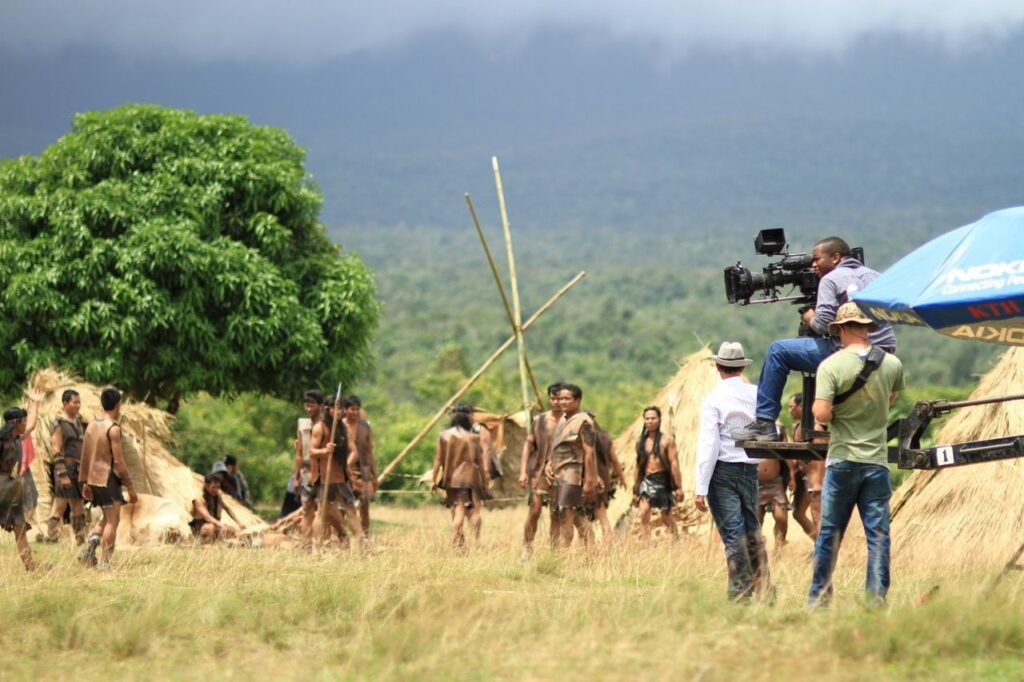
This is the stage most people picture when they think of filmmaking: the cameras rolling, the actors performing, the director calling “action”. In the industry it is called principal photography, and it is when all the necessary footage and audio are captured. Filming is often the shortest phase of the whole process, even though it is the most intense.
A film set is a small, highly organised workplace. The director works with the actors on performance and with the cinematographer on the visual style — the choice of lenses, lighting and camera movement that gives each film its look. The production designer makes sure the world in front of the camera is right, down to the smallest prop. The sound team records dialogue and atmosphere on set, because clean sound captured during filming is far better than anything recreated later.
Because scenes are shot out of order, continuity is a constant challenge. Actors may film the emotional climax of their story on the first morning and the quiet opening scene weeks later, so they must hold the whole arc of the character in their heads. A script supervisor keeps detailed notes and photographs of every shot — where the actors stood, what they wore, which hand held the coffee cup — so that the pieces will fit together in the edit.
4. Post-Production: Building the Film
Post-production turns the recorded footage into a finished film. It is the longest and most painstaking part of the process after development, and it is where the movie is truly made — because the film that audiences see is not the film that was shot, but the film that was assembled from it.
Editing comes first. The editor starts with an assembly cut, putting all the scenes together in story order, then works through rough cuts and fine cuts until the film reaches picture lock — the point at which the order and length of shots stop changing. The performances, the pacing and even the meaning of scenes can change completely in the cutting room.
Sound design runs alongside the edit. Dialogue recorded on set is cleaned up, missing lines are re-recorded in a studio in a process called ADR, and sound effects are built from scratch — footsteps, doors, weather, crowds. The composer writes and records the score, the music that tells the audience how to feel, often working to the locked picture so that the music lands on exactly the right moments.
Visual effects are added for anything that could not be filmed for real, from removing a modern building from a period street to creating entire digital worlds. Colour grading comes near the end: the colourist adjusts every shot so the film has a consistent look. Finally, all the sound is mixed together — dialogue, effects and music balanced into a single soundtrack — and the finished film is delivered to the distributor.
5. Distribution: Getting the Film to Audiences
The film is finished — now it must be distributed, the final stage of the filmmaking process. A distributor is the company that markets the film and puts it in front of audiences, and how it does that shapes almost everything about the film’s life.
Many films begin their public life at a film festival — Cannes, Venice, Toronto or Sundance — where critics and buyers see them first and the first reviews appear. A successful festival screening can build the word of mouth that carries a film into cinemas. From there, a film may open in theatres around the world, or go straight to a streaming platform, or do both. Theatrical releases are still the biggest stage a film can have, but streaming has become an equally important home for new films.
Marketing is part of distribution, not an afterthought. Trailers, posters, interviews and premieres are planned months in advance, and a film’s release date is chosen carefully — the biggest films are often held for the summer or for the Christmas season, when audiences are largest.
6. Awards Season: The Final Stage of a Film’s Life
For the most ambitious films of the year, the journey does not end at release. It ends at the awards ceremonies that close the film year — and for the films released in 2026, that season is happening right now.
The Governors Awards take place on 15 November 2026, Golden Globe nominations are announced on 7 December 2026, and Oscar shortlists arrive on 15 December 2026. The 84th Golden Globe Awards will be held on 10 January 2027, and the 99th Academy Awards will take place on Sunday 14 March 2027 at the Dolby Theatre in Hollywood, with nominations announced on 21 January 2027. Conan O’Brien returns to host the Oscars, and the eligibility period for the 99th Oscars covers films released between 1 January and 31 December 2026.
Awards matter to filmmakers for reasons beyond the trophies. A nomination can bring a small film to audiences who would never otherwise have found it, and a win can transform a director’s or actor’s career overnight. That is why studios campaign for months, and why the films released in November and December are so often the ones that dominate the awards conversation in January and March.
Why Does It Take So Long?
If you add the stages together, the answer becomes clear. Development can take months or decades. Pre-production usually runs for three to six months. Filming itself is often the shortest phase, measured in weeks. Post-production can take several more months, and distribution and awards campaigning stretch for a year after that.
It is also worth remembering that the process is not as neat as it looks on paper. The script can still be changing during the first days of the shoot, the edit can begin before the last shooting day, and a film can go back for additional shooting — known as reshoots — months after the cast has gone home. The five stages are a map, not a straight road.
The next time the lights go down and a film begins, remember what went into it: a writer alone with a blank page, a producer finding the money, a crew of hundreds planning every shot, actors performing scenes out of order, an editor finding the film inside the footage, and a distributor fighting to put it in front of you. A movie is not just recorded. It is built — one stage at a time, from script to screen.
Sources
- Wikipedia, “Filmmaking” — the five stages of film production — https://en.wikipedia.org/wiki/Filmmaking
- Careers in Film, “Filmmaking Fundamentals: The 5 Stages of Making a Film” — https://www.careersinfilm.com/filmmaking/
- Backstage, “Stages of Film Production: From Preproduction to Movie Marketing” — https://www.backstage.com/magazine/article/film-production-stages-76000/
- Soundstripe, “Film Production Process: The 5 Stages of Filmmaking” — https://www.soundstripe.com/blogs/film-production-process
- Final Draft, “How are Movies Made?” — https://www.finaldraft.com/blog/how-are-movies-made
- Entertainment Weekly, “2026-2027 awards season calendar: Key dates for Oscars, Grammys, Golden Globes, every major show” — https://ew.com/2026-2027-awards-season-calendar-key-dates-oscars-12196723
- Media Pavilion, “Oscars vs Emmys vs Grammys vs Golden Globes” — 99th Academy Awards key dates — https://www.mediapavilion.net/oscars-vs-emmys-vs-grammys-vs-golden-globes/
- Chime Infos, “2027 Academy Awards Predictions” — Governors Awards 15 November 2026; shortlists 15 December 2026; nominations 21 January 2027; ceremony 14 March 2027 — https://www.chimeinfos.com/2027-academy-awards-predictions-odyssey-leads-with-14-noms