
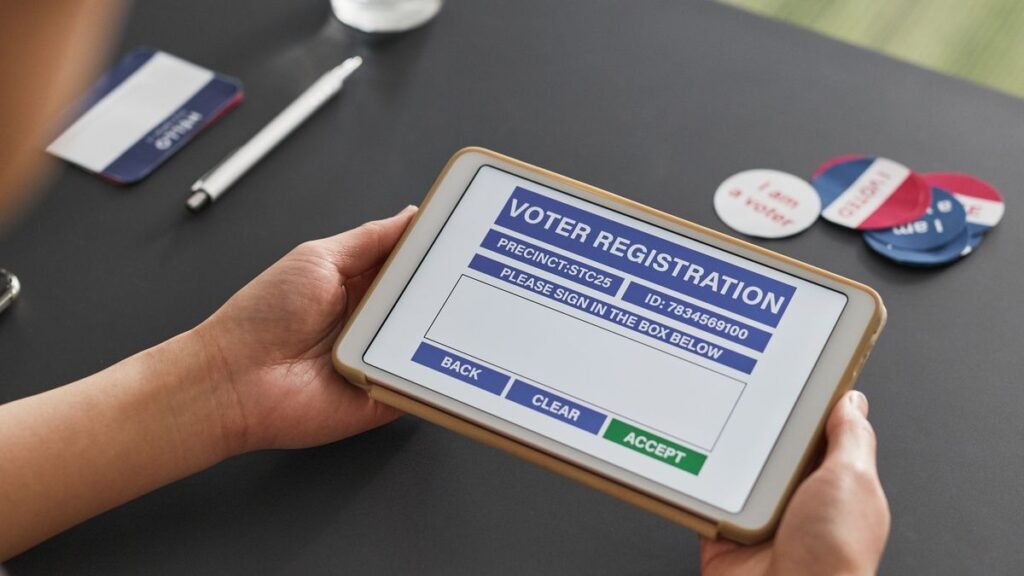
The general election on Tuesday, November 3, 2026, has just passed — the right moment to sort out your voter registration, not the week before the next election, when deadlines are already closing. Registration problems are almost always fixable if you find them early, and almost always fatal to your vote if you find them on Election Day.
This guide explains how to check your voter registration status, how to register or update it, how mail-in and absentee ballots work, how to track your ballot, and what identification you may need at the polls. The rules are set state by state — but there is a single official starting point, and this guide begins there.
Start at Vote.gov — the official federal portal
Vote.gov is the official website of the United States government for voting. It is a portal, not a rulebook: it does not register you itself, and it holds no national voter list. Select your state, and Vote.gov sends you to your state’s official election website, where you can register, update your registration, and check your status.
The Vote.gov homepage also links to answers on mail-in and absentee voting, early voting, voter ID, checking your status, and changing your address or party.
Use Vote.gov, or your state election authority’s own website, as your starting point. Do not rely on a link in a text message or social-media post — lookalike sites and misleading messages circulate before every election.
How to check your registration status
Checking takes a few minutes, and it is worth doing before every election, even if you voted last time — you may have moved, your record may have been marked inactive, or your polling place may have changed. Go to Vote.gov, select your state, and follow the link to check your registration status, or go directly to your state election authority’s website.
Most lookup tools ask for your name, date of birth, and county or address. The lookup will confirm whether you are registered, the address your registration is tied to, and often your polling place and party affiliation.
Vote.gov warns that a registration can be marked “inactive” if a voter did not vote in at least two federal elections and did not respond when election officials tried to contact them. An inactive record does not necessarily mean you cannot vote, but update or re-register well before the next election. If the lookup cannot find you, check again with your local election office — if you registered very recently, the voter file may not have updated yet.
If you have moved, update your registration: a move within the same state usually means updating the address on your existing record, while a move to a different state usually means registering there. Updating your address with the Department of Motor Vehicles or the post office does not automatically update your voter registration.
Who can register, and how
To register to vote in the United States, you must be a US citizen and at least 18 years old by Election Day; most states also let 16- and 17-year-olds pre-register. Residency rules, and eligibility after a felony conviction, vary by state, and Vote.gov routes you to your state’s rules.
There are three usual ways to register: online, by mail, and in person. Online registration is available in 40 states, according to Vote.org. By mail, voters use the National Mail Voter Registration Form, available through Vote.gov. In person, you can usually register at your local election office, and in many states at a Department of Motor Vehicles office as well.
Registration deadlines: there is no national deadline
This is the single most important fact in this guide: there is no national voter registration deadline. Vote.gov states it plainly — deadlines vary by state. In some states the last day to register is 30 days before Election Day; in others, you can register on Election Day itself.
Texas requires registration at least 30 days before Election Day. New York required registration 21 days before the November 3, 2026, election, with its online deadline on October 24, 2026. Pennsylvania’s deadline for the same election was 15 days before Election Day, on October 19, 2026, and California’s standard deadline is also 15 days before Election Day.
A growing group of states allow same-day registration: you register and vote in the same visit. California allows conditional registration up to and including Election Day; Colorado allows voters to register and cast a ballot in person up through Election Day; Minnesota and Wisconsin allow registration at the polling place on Election Day, with proof of residence; Nevada allows registration during early voting and on Election Day. North Carolina allows it during early voting, but not on Election Day itself. North Dakota has no voter registration at all.
Mail-in and absentee ballots: who can get one, and how
Every state allows some form of mail-in or absentee voting, but the rules fall into three broad systems, and which one you live under decides whether you need to request a ballot.
First, eight states plus the District of Columbia automatically mail a ballot to every active registered voter, with no request needed: California, Colorado, Hawaii, Nevada, Oregon, Utah, Vermont, and Washington. Oregon has run all-mail elections since 2000, Washington since 2011, and Colorado since 2013. Note one change: Utah has legislated an end to its automatic system, and from 2029 its voters will have to request a ballot again.
Second, in most other states, any registered voter may request a mail ballot without giving a reason — so-called no-excuse absentee voting. Thirty-seven states plus the District of Columbia fall in this group. Third, thirteen states still require an approved excuse, such as illness, travel, or age, before they will send a ballot.
Where a request is needed, apply online through your state election authority, or complete a paper application and return it by mail or in person. Requests can take about a week to process, and ballots are typically sent out 30 to 45 days before an election, so apply early.
Request deadlines vary just as registration deadlines do. For the November 3, 2026, election, New York required mail-ballot applications to reach the county board at least ten days before the election, with the online deadline on October 24, 2026. Those dates have passed; they show how much deadlines differ from state to state, not dates to use next time.
Returning your ballot and tracking it
Requesting the ballot is only half the job. Returning it correctly, and on time, is the other half. Some states count a ballot postmarked by Election Day and received within a few days afterwards; others require it to be in the election office’s hands by the time polls close.
For the November 3, 2026, election, New York required mail ballots to be postmarked by November 3 and received by the county board of elections by November 10. Massachusetts required ballots mailed domestically to be postmarked by November 3 and received by the local elections office by November 6. Never assume the postmark rule from one state applies in another.
Most states let you track your ballot online: New York through the Board of Elections’ voter lookup at voterlookup.elections.ny.gov; Pennsylvania at vote.pa.gov/MailBallotStatus; Massachusetts through its “Track My Ballot” search. After you return your ballot, check its status: if it shows as not received, or as challenged for a missing or mismatched signature, contact your local election office immediately — many states offer a short window to fix, or “cure,” a signature problem.
What ID do you need?
Voter ID rules are a third patchwork, and they apply to in-person voting. According to the National Conference of State Legislatures (NCSL), 36 states have laws requesting or requiring voters to show some form of identification at the polls, while 14 states and Washington, D.C., use other methods to verify identity. As of August 2026, 24 states ask for a photo ID and 12 also accept non-photo ID, such as a bank statement or utility bill.
In strict photo-ID states — including Arkansas, Georgia, Indiana, Kansas, Mississippi, New Hampshire, North Carolina, Ohio, Tennessee, and Wisconsin — a voter without an accepted photo ID generally casts a provisional ballot, which counts only if the voter returns with proper identification afterwards. In non-strict states, a voter without ID can usually sign an affidavit or have their identity verified another way and still cast a regular ballot. The Help America Vote Act also requires first-time voters who registered by mail to show identification in every state.
A five-minute checklist for the next election
Check your registration status on Vote.gov and update your address if you have moved. Confirm your polling place, and whether your state mails you a ballot automatically. If it does not, apply for a mail ballot well before your state’s request deadline — processing can take about a week. Note the return deadline and the tracking link, and check the tracking after you send the ballot back. Finally, check the ID rules for your state. Courts interpret voting rules too — see How Supreme Court Rulings Work and our report Supreme Court Blocks Trump Mail-In Voting Restrictions: What It Means for the Midterms. The lookup tools are free, official, and quick. Use them now, while there is time to fix whatever they find.
Sources
- Vote.gov, official US voting portal: Vote.gov
- Registration deadlines by state; no national deadline: Vote.org
- Online registration in 40 states; status checks: Vote.org
- Deadlines for Nov. 3, 2026, and same-day registration: Election Tracker
- All-mail voting states and Utah’s 2029 change: Ballotpedia
- No-excuse mail voting in 37 states plus D.C.; 13 require an excuse (NCSL, July 2026): Liberty Tribune
- Mail ballot request and return rules for November 3, 2026 (New York; Massachusetts): NY Board of Elections
- Voter ID laws — 36 states request or require ID; 24 photo, 12 non-photo as of August 2026 (NCSL): NCSL
Pingback: What Is the Electoral College? How US Presidential Elections Are Decided - WorldForbes