
Introduction
Strait of Hormuz deal 2026 — is the world’s most critical oil chokepoint finally about to reopen? Millions of people are searching for the full story right now. Furthermore, on August 6, 2026, Oman agreed to the framework of a deal with Iran to temporarily reopen the Strait of Hormuz — the global crude oil export route that the United States and Iran have been wrestling to control since the war began in February. However, the deal comes with conditions that the Trump administration has sharply disputed — including Iran’s demand to ban U.S. and Israeli ships from the waterway and charge tolls on vessels from what it calls “hostile countries.” Moreover, while two Middle East diplomats confirmed the framework exists, key details remain unresolved and Iran insists a bilateral agreement with Oman alone cannot automatically reopen the strait. As a result, the Strait of Hormuz deal 2026 is simultaneously the most hopeful development in the global energy crisis and one of the most contested. In this article, we cover everything about the Strait of Hormuz deal 2026 and exactly what it means going forward. So let us get started!
Strait of Hormuz Deal 2026? The Direct Answer
Strait of Hormuz Deal 2026 — What Was Agreed
The Strait of Hormuz deal 2026 framework was confirmed on August 6 by two Middle East diplomats with direct knowledge of the negotiations. Furthermore, Oman agreed to a framework with Iran that would temporarily reopen the Strait of Hormuz by establishing new shipping corridors — with commercial vessels entering the Persian Gulf through an Iranian-controlled northern route and exiting through a southern route controlled by Oman. Moreover, Iran’s Foreign Ministry spokesman Esmaeil Baghaei confirmed that the two countries have agreed on the geographical coordinates of the proposed safe shipping route, and that a joint statement is in the final drafting stage. As a result, the Strait of Hormuz deal 2026 is further advanced than at any previous point in the five-month crisis.
Strait of Hormuz Deal 2026 — What The US Says
The Strait of Hormuz deal 2026 has been met with sharp pushback from the Trump administration on one critical issue. Furthermore, a U.S. official told reporters on condition of anonymity that “any temporary routes will be without any impediments — meaning no approvals or permissions and no tolls or charges. The Strait of Hormuz is an international waterway and no party controls the lanes or the ability to transit through them.” Moreover, President Trump has repeatedly balked at any deal that would grant Iran more control over the strait — viewing the question of who controls passage as a fundamental matter of U.S. credibility and naval supremacy in the region. As a result, the gap between what Iran is offering and what the U.S. is willing to accept remains one of the central unresolved tensions in the Strait of Hormuz deal 2026 negotiations.
Strait of Hormuz Deal 2026? What Iran Is Demanding
Strait of Hormuz Deal 2026 — The US and Israel Ship Ban
The most controversial element of the Strait of Hormuz deal 2026 is Iran’s demand to bar U.S. and Israeli ships from transiting the waterway entirely. Furthermore, Iran’s parliament is reviewing a plan that would ban ships linked to the United States, Israel, and other so-called “hostile countries” from transiting the Strait of Hormuz — and require compensation payments from those countries before their vessels would be allowed to pass. Moreover, the Trump administration has flatly rejected this demand, calling it legally and strategically unacceptable — since the United States does not recognize Iran’s right to restrict freedom of navigation in an international waterway. As a result, the ship ban demand represents the single biggest obstacle between the current framework and a deal that the U.S. can actually accept.
Strait of Hormuz Deal 2026 — The New Middle Corridor Route
The Strait of Hormuz deal 2026 also proposes a significant change to the physical routing of ships through the waterway. Furthermore, the proposed framework would create a new “middle corridor” through the Strait of Hormuz — eventually replacing the existing northern and southern routes while ensuring safe navigation. Moreover, under the proposed arrangement, temporary routes near Iran’s Larak Island and through Omani territorial waters would close, with parts of the new inbound and outbound corridors passing through Iranian waters — a significant departure from the decades-old system under which commercial traffic traveled primarily through Omani waters. As a result, the new routing would give Iran a greater physical role in managing traffic through the strait than it has held under any previous arrangement.
Here is a quick overview of the Strait of Hormuz deal 2026 key details:
| Detail | Information |
|---|---|
| Agreement date | August 6, 2026 — framework agreed in principle |
| Parties | Iran and Oman — U.S. not a direct party |
| New inbound route | Iranian-controlled northern corridor |
| New outbound route | Oman-controlled southern corridor |
| Joint statement | In final drafting stage as of August 6 |
| Duration | Initial 2-4 months — possibly longer |
| Iran’s demand | Ban on U.S. and Israeli ships — tolls on hostile nations |
| U.S. position | No tolls, no bans, no approvals — international waterway |
| Implementation | Requires separate decision by Iran’s senior leadership |
| Oil market reaction | Brent crude fell from $100+ toward $80 on deal news |
| Pre-war traffic | Approximately 130 ships per day — 20% of global oil supply |
Furthermore, this overview shows just how much complexity lies beneath the headline news of a “deal” being reached. As a result, the Strait of Hormuz deal 2026 is best understood as a framework that still requires resolution of several critical disputes before it becomes operational.
Strait of Hormuz Deal 2026? The Background on the Crisis
Strait of Hormuz Deal 2026 — How The Crisis Started
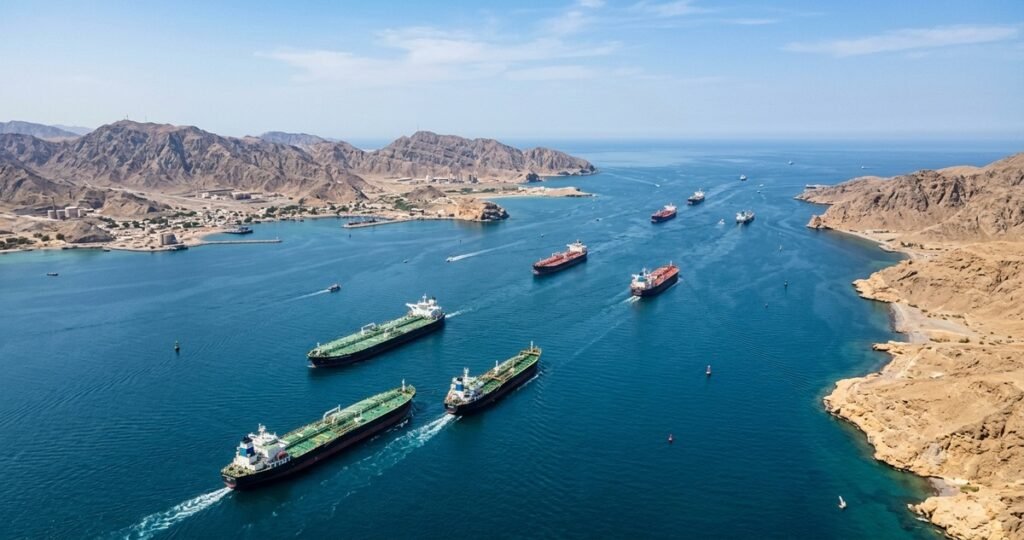
Understanding the Strait of Hormuz deal 2026 requires knowing what created the crisis in the first place. Furthermore, shipping traffic through the Strait of Hormuz has been largely blocked by Iran since February 28, 2026, when the United States and Israel launched coordinated air strikes against Iran — and in retaliation, Iran launched missile and drone attacks on U.S. military bases, Gulf states, and began restricting maritime traffic through the strait it controls. Moreover, before the war, the strait carried approximately 20 percent of the world’s oil supply — around 130 ships per day — making it the single most critical energy transit point on earth. As a result, its closure has produced a global energy crisis that pushed Brent crude oil above $100 per barrel and disrupted supply chains across the entire world economy.
Strait of Hormuz Deal 2026 — The June 17 Agreement That Collapsed
The Strait of Hormuz deal 2026 framework builds on — and attempts to repair — an earlier agreement that fell apart. Furthermore, on June 17, 2026, Iran and the U.S. signed a memorandum of understanding that included an Article 5 provision under which Iran agreed to allow commercial vessels to pass through the Strait of Hormuz without charge for 60 days. Moreover, vague wording in that June agreement led to immediate disagreements about who had ultimate control over the strait and which routes ships could use — and the temporary arrangement subsequently collapsed in June following fresh Iranian attacks on vessels in the waterway. As a result, the August 2026 Oman-mediated talks are specifically designed to address the ambiguities in the June agreement that led to its breakdown.
Strait of Hormuz Deal 2026? The Global Economic Stakes
Strait of Hormuz Deal 2026 — What Reopening Would Mean For Oil Prices
The Strait of Hormuz deal 2026 has enormous implications for global energy markets. Furthermore, Brent crude oil surged above $100 per barrel at the height of the Hormuz closure — its highest level since the early days of the Russia-Ukraine war — before falling back toward $80 per barrel as deal news emerged. Moreover, energy analysts estimate that a full reopening of the Strait of Hormuz to normal commercial traffic could push oil prices down by as much as $15 to $20 per barrel from current elevated levels — providing significant relief to consumers, airlines, and manufacturers worldwide who have been absorbing higher energy costs since February. As a result, the Strait of Hormuz deal 2026 is not just a geopolitical story — it is a story with direct consequences for the cost of living for hundreds of millions of people worldwide.
Strait of Hormuz Deal 2026 — The Casualty Toll of the Crisis
The Strait of Hormuz deal 2026 is also the culmination of a maritime crisis that has cost lives and ships. Furthermore, since the closure began in February 2026, one tugboat has been sunk, at least 17 merchant ships have been damaged — seven of which were abandoned by their crews — two merchant ships have been captured, 12 seafarers have been killed or reported missing, and one port worker was killed with two more wounded in Bahrain. Moreover, beyond the direct human toll, the diversion of shipping through alternative routes has added thousands of miles to voyages and billions of dollars in additional costs across the global supply chain. As a result, the pressure to reach a Strait of Hormuz deal 2026 comes not just from oil markets but from the very real human and economic costs that have been accumulating every day the waterway has remained effectively closed.
Frequently Asked Questions (FAQs)
Q1: What is the Strait of Hormuz deal 2026? The Strait of Hormuz deal 2026 is a framework agreement between Iran and Oman to temporarily reopen the Strait of Hormuz by establishing new shipping corridors — with vessels entering through an Iranian-controlled northern route and exiting through an Omani southern route. Furthermore, the deal was confirmed in principle on August 6, 2026, with a joint statement in the final drafting stage. As a result, it is the most advanced diplomatic framework yet to address the global shipping crisis triggered by the U.S.-Iran war.
Q2: Why is Iran trying to ban U.S. ships from the Strait of Hormuz? Iran’s parliament is reviewing a plan to ban ships linked to the United States, Israel, and other hostile countries from the strait — and charge tolls on vessels from those nations. Furthermore, Iran views this as asserting its rights as a coastal state with sovereignty over the northern half of the waterway. As a result, the U.S. has flatly rejected this demand, calling it inconsistent with international maritime law.
Q3: Has the Strait of Hormuz deal been finalized? No. As of August 6, 2026, the framework has been agreed in principle but a joint statement is still in the final drafting stage. Furthermore, several critical issues remain unresolved — including the U.S.-Israeli ship ban demand, toll requirements, and the question of who ultimately controls passage. As a result, the deal could still collapse if these disputes are not resolved.
Q4: What happened to the June 17 Hormuz agreement? The June 17 agreement gave Iran and the U.S. a temporary 60-day framework for commercial shipping through the strait — but collapsed due to vague wording about who controlled the routes and following fresh Iranian attacks on vessels in the waterway. Furthermore, the August 2026 Oman-mediated talks are specifically designed to address those ambiguities. As a result, the new framework attempts to be more explicit about routing, control, and conditions than the June agreement was.
Q5: How has the Hormuz closure affected oil prices? Brent crude surged above $100 per barrel at the height of the closure — before falling back toward $80 per barrel on deal news. Furthermore, a full reopening could push prices down by an estimated $15 to $20 per barrel from elevated levels. As a result, the Strait of Hormuz deal 2026 is one of the most consequential single diplomatic developments for global energy prices in years.
Q6: Is Oman a neutral party in this conflict? Oman has maintained a neutral position throughout the U.S.-Iran war — a stance it has historically adopted in regional conflicts. Furthermore, it sits on the southern shore of the Strait of Hormuz and has served as the primary back-channel mediator between Washington and Tehran throughout the crisis. As a result, Oman is uniquely positioned to broker a deal that both sides can accept — though whether it can bridge the remaining gaps remains to be seen.
Conclusion
So what is the full story of the Strait of Hormuz deal 2026? The answer is that the world is closer to a partial reopening of the globe’s most critical oil shipping chokepoint than at any previous point in the five-month U.S.-Iran war — but significant obstacles remain. Furthermore, Oman agreed on August 6, 2026 to a framework with Iran that would establish new shipping corridors through the strait — with commercial vessels entering through an Iranian-controlled northern route and exiting through an Omani southern corridor — and a joint statement is in its final drafting stage. Moreover, Iran’s demands to ban U.S. and Israeli ships and charge tolls on hostile nations remain sharply disputed by the Trump administration, which insists the strait is an international waterway that no party controls. As a result, the Strait of Hormuz deal 2026 is the most important ongoing diplomatic development in the global energy crisis — and the next 48 to 72 hours could determine whether it becomes a genuine breakthrough or the latest in a series of deals that promised more than they delivered.
Stay tuned to WorldForbes for the latest updates on the Strait of Hormuz deal 2026, US Iran war news, and global energy market developments as they happen.
Pingback: Spheres On A Sushi Roll: Everything You Need To Know in 2026 - WorldForbes
Pingback: A Fireman Leaned A 36 Foot Ladder Against A Building: Everything You Need To Know in 2026 - WorldForbes
Pingback: Luigi Mangione Guilty Plea: The Full Story of the UnitedHealthcare CEO Shooting in 2026 - WorldForbes