
Introduction
When catastrophic flooding hit Mohave County, Arizona in September 2025, one man was at the center of the emergency response — County Manager and County Engineer Sam Elters. The storms that struck between September 25 and 27, 2025 caused more than $30 million in documented damage to roads, facilities, and critical infrastructure across western Arizona. What followed was a frustrating battle for federal disaster relief that ultimately ended in denial — and a public fight that made national news.
This is the complete story of Sam Elters, Mohave County’s flood response, and what happened when FEMA said no.
Sam Elters: Who Is He?
The Man Behind Mohave County
Sam Elters is not a politician. He is an engineer — and that engineering background has defined his entire approach to county management. He served as the Arizona Department of Transportation’s State Engineer from 2005 to 2008. He then built a career spanning both the public and private transportation sectors before becoming Mohave County Manager in 2020.
Here are the essential facts about Sam Elters:
| Detail | Information |
|---|---|
| Role | Mohave County Manager and County Engineer |
| Started as County Manager | 2020 |
| Professional Background | Transportation engineer — public and private sectors |
| Previous Role | Arizona DOT State Engineer 2005-2008 |
| Arizona State Transportation Board | Appointed by Governor Hobbs — May 2024 |
| Retirement | Early 2026 — after 6 years as County Manager |
| Recognition | CMA Plaque — February 13, 2026 |
Governor Katie Hobbs appointed Elters to serve on the Arizona State Transportation Board in May 2024 — recognizing his transportation expertise and his decades of public service. His appointment represented the western Arizona district including La Paz, Mohave, Yavapai, and Yuma counties.
Sam Elters Flood Response: The September 2025 Disaster
What Happened
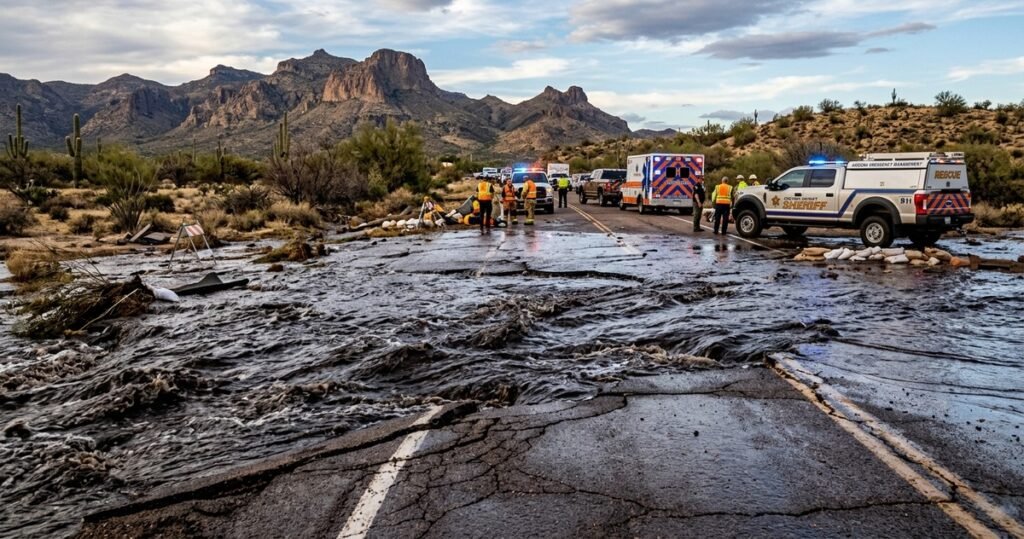
Between September 25 and 27, 2025, severe storms struck Gila and Mohave Counties in Arizona. The flooding was described as historic in scale — causing widespread damage to public infrastructure, homes, and critical services across local and tribal communities.
The damage was documented and quantified quickly. Preliminary damage assessments confirmed more than $30 million in losses — a figure that far exceeded the thresholds historically used to justify federal disaster assistance. Roads were washed out. County facilities were damaged. Tribal communities were severely affected. The infrastructure that western Arizona communities depend on had been devastated by a multi-day storm system that overwhelmed drainage systems and watercourses across the region.
Sam Elters spoke directly about the scale of what Mohave County faced. He confirmed that the September 2025 storms resulted in significant flooding and caused widespread, severe, and extensive damage in multiple areas of Mohave County, including roadways and facilities. His statement was measured and factual — the voice of an engineer assessing damage, not a politician seeking attention.
The Road to FEMA
Arizona Governor Katie Hobbs submitted a formal request for a Major Disaster Declaration to FEMA — covering the September 25-27, 2025 flooding in Gila and Mohave Counties. The declaration request sought two specific types of assistance:
- Public Assistance — federal funding to help local governments repair damaged infrastructure
- Statewide Hazard Mitigation — funding for measures to reduce future disaster damage
The damage documentation was thorough. The dollar figures were clear. The human impact was real and well-documented. And the request appeared to meet — and exceed — the historical thresholds for federal assistance.
Then FEMA said no.
Sam Elters Flood Response: FEMA Denies Arizona
The Denial That Shocked Arizona
The Federal Emergency Management Agency informed the State of Arizona that its request for a Major Disaster Declaration had been denied. FEMA concluded that the impacts did not exceed state and local capacity — effectively saying that Arizona and its counties could handle the $30 million-plus in damage on their own.
The decision was immediately and forcefully condemned. Governor Hobbs publicly condemned FEMA’s denial — pointing out that the documented damages far exceeded the thresholds historically used to justify federal disaster assistance. FEMA had declined to validate the documented damages despite clear evidence of widespread destruction.
Sam Elters’ Response
Sam Elters responded to the FEMA denial by fully supporting Governor Hobbs’ efforts to challenge the decision. He said that Mohave County fully supports the Governor’s efforts to request and seek FEMA’s approval. His measured but firm endorsement of the appeal reflected the frustration of a county engineer who had documented $30 million in real damage and watched a federal agency dismiss it.
Miami Mayor’s Reaction
Miami, Arizona Mayor Gil Madrid also responded with frustration. He described Miami as a strong and resilient community while acknowledging that the FEMA denial would have a real impact on families and businesses. He committed to continuing to work with state and local partners to seek federal support — and urged the Department of Homeland Security to reconsider the decision.
Here is a complete timeline of the Mohave County flood response:
| Date | Event |
|---|---|
| September 25-27, 2025 | Catastrophic flooding hits Gila and Mohave Counties |
| October 2025 | Preliminary damage assessments confirm $30M+ in losses |
| November 2025 | Arizona submits Major Disaster Declaration request to FEMA |
| December 23, 2025 | FEMA denies Arizona’s disaster declaration request |
| December 2025 | Governor Hobbs publicly condemns FEMA denial |
| December 2025 | Sam Elters supports Governor’s appeal efforts |
| Early 2026 | Sam Elters announces retirement plans |
| February 13, 2026 | Elters honored with CMA plaque at retirement |
Sam Elters Flood Response: The FEMA Denial in Context
Why FEMA Denials Matter
The FEMA denial of Arizona’s disaster declaration request was not just frustrating for Mohave County — it was part of a broader and deeply concerning pattern. Across the United States, communities that experience significant natural disasters are increasingly finding that FEMA’s disaster declaration process does not work as expected.
When FEMA denies a Major Disaster Declaration request, communities lose access to:
- Public Assistance funding for infrastructure repair
- Individual Assistance for affected residents
- Hazard Mitigation grants for future disaster prevention
- Federal contractors and resources for cleanup and recovery
Without federal assistance, the entire cost of recovery falls on state and local governments — and ultimately on taxpayers in the affected communities. For a county like Mohave — which covers a large, largely rural area in western Arizona — absorbing $30 million in infrastructure damage without federal help is a genuinely serious financial burden.
The Broader Pattern
The Mohave County situation reflects a broader challenge in America’s disaster response system. FEMA’s disaster declaration thresholds and criteria have been criticized for being inconsistently applied and for failing to account for the particular vulnerability of rural communities with limited tax bases and infrastructure budgets.
A large urban county can more easily absorb $30 million in disaster damage than a rural county whose entire annual budget may be only a few times that amount. The one-size-fits-all approach to disaster declaration thresholds disadvantages exactly the kinds of communities that need federal help most.
Sam Elters: His Other Achievements as County Manager
Restructuring Emergency Management
One of Sam Elters’ significant administrative decisions as County Manager came in May 2025 when he announced the restructuring of Mohave County’s Risk and Emergency Management departments. When Risk and Emergency Management Director Joe Dorner resigned to take a teaching and coaching position at Lee Williams High School, Elters saw an opportunity to make organizational improvements.
Elters explained that Risk and Emergency Management had been merged years ago but should be separated. He said there is a clear difference in functions between Risk and Emergency Management and that he planned to make an administrative change to realign these two divisions with other departments where there is a better and more natural alignment. This kind of thoughtful organizational restructuring reflects the management philosophy of an engineer — always looking for ways to make systems work more efficiently.
Arizona State Transportation Board
Governor Hobbs’ appointment of Sam Elters to the Arizona State Transportation Board in May 2024 recognized his unique combination of county management experience and deep transportation expertise. As a member of the board representing western Arizona, Elters helped prioritize transportation needs, projects, and funding for La Paz, Mohave, Yavapai, and Yuma counties — a region with significant infrastructure challenges given its vast geography and relatively small population.
Retirement and Recognition
In August 2025, Sam Elters informed the Mohave County Board of Supervisors that he planned to retire in early 2026. His announcement was met with genuine sadness from his colleagues. Supervisor Rich Lettman said the news saddened him and described Elters as great at assisting him. Supervisor Don Martin was equally warm in his reaction — calling Elters “the man” and expressing real sadness at his departure.
On February 13, 2026, the County Managers and Administrators Association honored Sam Elters with a commemorative plaque recognizing his six years of outstanding service as County Manager. His colleagues noted that he was always a kind and supportive presence at any CMA event — grateful not just for his service to Mohave County but for his support of county government across Arizona.
Mohave County: Understanding the Region
What is Mohave County?
Mohave County is the fifth-largest county by area in the contiguous United States — covering more than 13,000 square miles of western Arizona. It borders Nevada and California and includes communities like Kingman, Lake Havasu City, Bullhead City, and Laughlin’s Arizona neighbor Mohave Valley.
Here are the key facts about Mohave County:
| Detail | Information |
|---|---|
| Location | Northwestern Arizona — borders Nevada and California |
| Area | Over 13,000 square miles |
| County Seat | Kingman, Arizona |
| Major Communities | Kingman, Lake Havasu City, Bullhead City |
| Population | Approximately 215,000 |
| Geography | Desert landscape — Colorado River forms western border |
| Economy | Tourism, retirement communities, manufacturing |
The county’s vast geography — combined with its desert terrain and monsoon weather patterns — makes flood management a perennial challenge. The same dry washes and arroyos that sit empty for most of the year can become raging torrents during monsoon season, capable of destroying roads and infrastructure that took years to build.
Flood Risk in Western Arizona
Western Arizona faces a distinctive flood risk profile. The combination of hard desert soils, steep terrain, and intense monsoon rainfall creates conditions where flash flooding can develop with very little warning. Communities in Mohave County are accustomed to monsoon season — but the September 2025 storms were described as exceptional in their intensity and geographic reach.
The $30 million in documented damage from a single three-day storm event underscores just how vulnerable western Arizona’s infrastructure is to these periodic extreme events. And the FEMA denial — which left Mohave County without federal assistance to repair that damage — makes the work of county managers like Sam Elters even more critical.
Frequently Asked Questions (FAQs)
Q1: Who is Sam Elters and what was his role in the Mohave County flood response? Sam Elters is the Mohave County Manager and County Engineer who led the county’s response to the September 2025 flooding. He documented more than $30 million in damages and supported Governor Hobbs’ push for a federal disaster declaration. As a result, he was one of the most visible local officials in Arizona’s fight for FEMA assistance after the historic floods.
Q2: What caused the flooding in Mohave County in September 2025? Severe storms between September 25 and 27, 2025 caused catastrophic flooding across Gila and Mohave Counties in Arizona. The storms produced widespread damage to roads, facilities, and critical services. As a result, Arizona submitted a Major Disaster Declaration request to FEMA documenting more than $30 million in losses.
Q3: Why did FEMA deny Arizona’s disaster declaration request? FEMA concluded that the impacts of the September 2025 flooding did not exceed state and local capacity — effectively ruling that Arizona could handle the recovery without federal assistance. This decision was immediately condemned by Governor Hobbs and local officials who pointed out that the documented damages far exceeded historical thresholds for federal assistance.
Q4: What did Sam Elters say about the flood damage? Elters confirmed that the September 2025 storms resulted in significant flooding and caused widespread, severe, and extensive damage in multiple areas of Mohave County including roadways and facilities. He fully supported Governor Hobbs’ efforts to appeal FEMA’s denial and seek federal assistance for the affected communities.
Q5: When did Sam Elters retire as Mohave County Manager? Sam Elters announced his retirement plans in August 2025 and retired in early 2026 after six years as County Manager. He was honored by the County Managers and Administrators Association with a commemorative plaque on February 13, 2026, recognizing his outstanding service.
Q6: What other roles did Sam Elters hold before becoming County Manager? Before becoming Mohave County Manager in 2020, Elters served as Arizona DOT State Engineer from 2005 to 2008 and built a career spanning both public and private transportation sectors. In May 2024, Governor Hobbs also appointed him to the Arizona State Transportation Board. As a result, he brought decades of engineering and transportation expertise to the County Manager role.
Q7: What is the significance of the FEMA denial for Mohave County? The FEMA denial means Mohave County must absorb the cost of recovering from more than $30 million in flood damage without federal assistance. For a rural county with a limited tax base, this represents a significant financial burden. As a result, the denial has been seen as a failure of the federal disaster response system to account for the particular vulnerability of rural communities.
Conclusion
Sam Elters served Mohave County for six years with the quiet competence of an engineer who cared deeply about infrastructure and public service. When the September 2025 floods hit — causing over $30 million in damage across western Arizona — he led the county’s response with the same methodical precision that had defined his entire career.
The FEMA denial was a frustrating end to a chapter that deserved a better outcome. Thirty million dollars in documented damage. Historic flooding. Communities devastated. And the federal government said the impacts did not exceed state and local capacity. Governor Hobbs condemned the decision. Sam Elters supported the appeal. And Mohave County was left to figure out how to rebuild without the federal help it had every reason to expect.
Sam Elters retired in early 2026 honored by his peers and respected by his community. The flood response controversy was one of the last major challenges of his career — and his handling of it reflected exactly the kind of steady, principled leadership that Mohave County needed at its most difficult moment.
Stay tuned to WorldForbes for the latest local government news, disaster response coverage, and Arizona updates throughout 2026.
Pingback: HomePod Mini 2: Everything You Need To Know in 2026 - WorldForbes