
Introduction
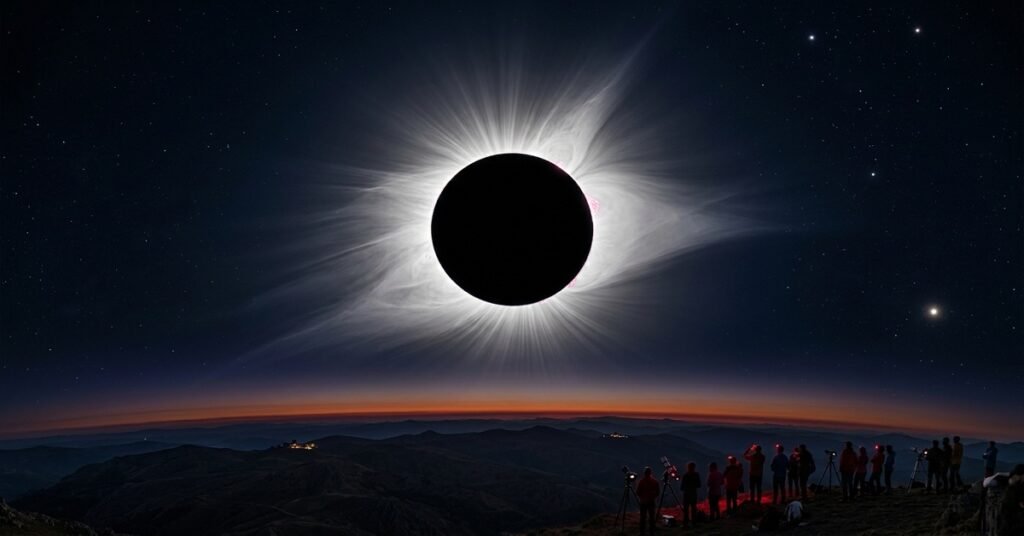
Total solar eclipse August 12 2026 — one of the most spectacular astronomical events of the decade is happening today. Millions of skywatchers across the world are searching for the exact path, the best viewing times, and everything they need to know to safely experience this rare phenomenon. Furthermore, the August 12, 2026 total solar eclipse is the only total solar eclipse of the entire year — a narrow band of totality sweeping across eastern Greenland, western Iceland, and northern Spain in a celestial event that Europe has not witnessed since 2015. However, while the path of totality misses the continental United States, millions of Americans across 26 states will still be able to see a meaningful partial solar eclipse today. Moreover, the event will be immediately followed by the peak of the Perseid meteor shower tonight — creating one of the richest nights of skywatching in years. As a result, the total solar eclipse August 12 2026 is an event no astronomy enthusiast should miss. In this article, we cover everything about the total solar eclipse August 12 2026 and exactly where, when, and how to watch it safely. So let us get started!
Total Solar Eclipse August 12 2026? The Direct Answer
Total Solar Eclipse August 12 2026 — Where Totality Is Happening
The total solar eclipse August 12 2026 path of totality is a narrow band approximately 180 miles wide that sweeps across eastern Greenland, western Iceland, the North Atlantic Ocean, and northern Spain — with a small portion also crossing the extreme northeastern corner of Portugal. Furthermore, the longest totality of the entire eclipse — lasting 2 minutes and 18 seconds — will occur offshore near Iceland, close to the center of the Moon’s shadow over the North Atlantic. Moreover, this is the first total solar eclipse visible from mainland Europe since 1999 — and the first visible from Spain since the famous 2015 eclipse — making it an extraordinary moment for European skywatchers who have waited over two decades for totality to return to their skies. As a result, major European cities including Madrid, London, and Paris will see at least 90 percent totality — a deep and dramatic partial eclipse that will noticeably darken skies and drop temperatures across the continent.
Total Solar Eclipse August 12 2026 — Can Americans See It
The total solar eclipse August 12 2026 is visible as a partial eclipse from 26 U.S. states — though none will experience the full totality that Europe and the far north will see today. Furthermore, the Moon’s dark central shadow — called the umbra — will miss the continental United States entirely, meaning no American city will experience the complete blackout that makes a total eclipse so spectacular. Moreover, the best view in the United States will be from Fairbanks, Alaska, where the eclipse will reach approximately 37 percent coverage of the Sun. As a result, Americans who want to experience totality will need to watch via live stream — CBS News is broadcasting live from Mallorca, Spain, where totality hits at approximately 2:30 p.m. Eastern Time.
Total Solar Eclipse August 12 2026? City-By-City Guide
Total Solar Eclipse August 12 2026 — US Cities and Their Partial Eclipse Coverage
The total solar eclipse August 12 2026 will be visible as a partial eclipse in dozens of U.S. cities — with coverage percentages varying significantly by location. Furthermore, Fairbanks, Alaska leads all U.S. cities with approximately 37 percent coverage, followed by cities in the northeastern United States that will see meaningful but modest partial coverage. Moreover, Boston will see approximately 16 percent coverage, New York City will see about 9 percent, Toronto will see about 8 percent, and Philadelphia will see approximately 7 percent. As a result, viewers in the northeastern United States will notice only a very small bite taken out of the Sun — but with proper eclipse glasses, even a partial eclipse is a genuinely remarkable sight.
Total Solar Eclipse August 12 2026 — European Cities and Their Coverage
The total solar eclipse August 12 2026 delivers a dramatically different experience for European viewers. Furthermore, the path of totality crosses directly through northern Spain — with the eclipsed Sun appearing low above the western horizon in Spanish cities between approximately 8:26 and 8:33 p.m. local time. Moreover, approximately 230 million people globally will be able to see 90 percent totality or more — primarily across Europe — making this one of the most widely witnessed high-coverage solar eclipse events in recent history. As a result, cities including Madrid, Paris, London, Amsterdam, and Berlin will all experience a deep, dramatic partial eclipse that noticeably darkens skies and reveals the faintest stars in the early evening.
Here is a quick city-by-city guide to the total solar eclipse August 12 2026 coverage:
| Location | Eclipse Coverage | Notes |
|---|---|---|
| Northern Spain (path of totality) | 100% | Totality between 8:26–8:33 PM local time |
| Western Iceland (path of totality) | 100% | Maximum totality 2 min 18 sec near Iceland |
| Eastern Greenland (path of totality) | 100% | Path of totality crosses eastern coast |
| Madrid, Spain | 100% — totality | Best major European city for full totality |
| Paris, France | ~90%+ | Deep partial — noticeably dark skies |
| London, UK | ~90%+ | Dramatic partial eclipse in evening sky |
| Amsterdam | ~90%+ | Evening partial eclipse, skies visibly darkened |
| Fairbanks, Alaska | ~37% | Best US location for partial eclipse |
| Boston, MA | ~16% | Small but visible partial eclipse |
| New York City, NY | ~9% | Visible with eclipse glasses |
| Toronto, Canada | ~8% | Small partial eclipse |
| Philadelphia, PA | ~7% | Requires eclipse glasses to notice |
Furthermore, this guide helps viewers in every major location understand exactly what they can expect to see today. As a result, anyone with eclipse glasses and a clear sky can participate in this rare astronomical event regardless of their location.
Total Solar Eclipse August 12 2026? What Time To Watch
Total Solar Eclipse August 12 2026 — Key Times in Universal Time
The total solar eclipse August 12 2026 reaches its maximum point — called greatest eclipse — at 17:47:06 UTC (Universal Coordinated Time). Furthermore, the partial phases of the eclipse begin earlier and end later than the totality window — with the Moon first appearing to touch the Sun’s disk well before greatest eclipse and the partial eclipse continuing for some time after totality ends in Spain. Moreover, for viewers in the United States watching via live stream, CBS News live coverage begins at 2:00 p.m. Eastern Time — with the Spanish totality moment hitting at approximately 2:30 p.m. Eastern. As a result, American viewers can easily catch the most spectacular moments of the eclipse from home by tuning in to CBS News or NASA’s live stream.
Total Solar Eclipse August 12 2026 — Perseid Meteor Shower Bonus Tonight
The total solar eclipse August 12 2026 comes with an extraordinary astronomical bonus that makes tonight one of the richest skywatching opportunities of the entire year. Furthermore, the Perseid meteor shower — one of the most reliable and spectacular annual meteor showers — reaches its peak tonight, just hours after the eclipse concludes. Moreover, the Perseids typically produce 50 to 100 meteors per hour under dark sky conditions at peak — with the shower’s fast, bright meteors making it one of the most visually impressive of the year. As a result, skywatchers who watch the eclipse this afternoon and then head outside tonight will experience two of astronomy’s most celebrated events back to back in a single extraordinary day.
Total Solar Eclipse August 12 2026? How To Watch Safely
Total Solar Eclipse August 12 2026 — Eclipse Glasses Are Essential
The total solar eclipse August 12 2026 requires proper eye protection for every viewer outside the path of totality — and for viewers in the path of totality during all phases except the brief moments of complete totality. Furthermore, looking directly at the Sun without certified eclipse glasses at any point during a partial eclipse can cause serious and permanent retinal damage — a condition known as solar retinopathy — because the retina has no pain receptors to warn of damage as it is occurring. Moreover, only viewers in the path of totality — in Greenland, Iceland, and northern Spain — can safely remove their eclipse glasses during the brief 2 minutes and 18 seconds of complete totality, and must put them back on immediately as the Moon begins to move off the Sun. As a result, anyone in the United States watching the partial eclipse today must wear certified ISO 12312-2 eclipse glasses for the entire duration of the event.
Total Solar Eclipse August 12 2026 — How To Watch Online
The total solar eclipse August 12 2026 can be watched safely and in spectacular detail through several official live streams. Furthermore, CBS News is broadcasting live with correspondent Rob Marciano reporting from Mallorca, Spain — one of the best locations in Europe for viewing totality. Moreover, NASA’s Scientific Visualization Studio is also hosting a live stream that will include expert commentary, real-time data, and multiple camera angles from both the ground and space. As a result, American viewers without eclipse glasses or in cloudy locations can still experience one of the most dramatic astronomical events of the year through these free live streams.
Total Solar Eclipse August 12 2026? When Is The Next US Eclipse
Total Solar Eclipse August 12 2026 — The Long Wait For America
The total solar eclipse August 12 2026 is a bittersweet moment for American eclipse chasers — spectacular for Europe but largely a spectator sport for the continental United States. Furthermore, the next total solar eclipse visible from the continental United States will not arrive until March 30, 2033 — though that eclipse will only reach a relatively narrow path. Moreover, the next major coast-to-coast eclipse event visible across many U.S. states will come in August 2045 — with a path of totality running through northern California, Nevada, Utah, Colorado, Kansas, Oklahoma, Texas, Arkansas, Mississippi, Alabama, Georgia, and Florida. As a result, Americans who experienced the spectacular April 8, 2024 eclipse that crossed from Texas to Maine have a significant wait ahead before totality returns to most of the country.
Total Solar Eclipse August 12 2026 — Why Eclipses Are So Rare
The total solar eclipse August 12 2026 is a reminder of the extraordinary cosmic coincidence that makes total solar eclipses possible at all. Furthermore, the Sun is approximately 400 times wider than the Moon — but it is also approximately 400 times farther away — which means the two objects appear almost exactly the same size in Earth’s sky. Moreover, this precise size match means that during a total eclipse, the Moon fits almost perfectly over the Sun’s disk — revealing the solar corona, a faint and breathtaking outer atmosphere that is normally invisible against the Sun’s overwhelming brightness. As a result, total solar eclipses are among the rarest and most awe-inspiring natural events visible from Earth — occurring somewhere on the planet roughly every 18 months but returning to any single location only once every approximately 400 years.
Frequently Asked Questions (FAQs)
Q1: Where is the total solar eclipse August 12 2026 path of totality? The path of totality crosses eastern Greenland, western Iceland, the North Atlantic Ocean, and northern Spain — with a small portion also reaching the extreme northeastern corner of Portugal. Furthermore, the longest totality of approximately 2 minutes and 18 seconds will occur offshore near Iceland. As a result, totality is entirely confined to the far North Atlantic and Europe — with no U.S. city experiencing complete blackout.
Q2: Can Americans see the total solar eclipse August 12 2026? Yes — as a partial eclipse. The best U.S. location is Fairbanks, Alaska at approximately 37 percent coverage, followed by northeastern cities like Boston at 16 percent and New York City at 9 percent. Furthermore, 26 U.S. states will see some partial coverage today. As a result, eclipse glasses are required for all U.S. viewers throughout the entire event.
Q3: What time does the eclipse reach totality today? Greatest eclipse occurs at 17:47:06 UTC. Furthermore, totality will be visible in northern Spain between approximately 8:26 and 8:33 p.m. local Spanish time — which corresponds to approximately 2:26 to 2:33 p.m. Eastern Time in the United States. As a result, American live stream viewers should tune in by 2:00 p.m. Eastern to catch the full build-up to totality.
Q4: Do I need eclipse glasses to watch today’s eclipse? Yes — absolutely. Anyone outside the path of totality must wear certified ISO 12312-2 eclipse glasses for the entire duration of the partial eclipse. Furthermore, looking at the Sun without eclipse glasses at any stage of a partial eclipse can cause permanent retinal damage with no warning pain. As a result, never look at the Sun today without certified eclipse glasses unless you are in the path of totality during the brief totality window.
Q5: Where can I watch the total solar eclipse August 12 2026 live? CBS News is broadcasting live from Mallorca, Spain starting at 2:00 p.m. Eastern Time, and NASA is hosting a live stream with expert commentary and multiple camera angles. Furthermore, both streams are free and accessible online. As a result, American viewers can experience totality from home through these official broadcasts.
Q6: When is the next total solar eclipse visible from the United States? The next total solar eclipse visible from the continental United States will occur on March 30, 2033 — though it will cross only a limited area. Furthermore, the next major multi-state coast-to-coast eclipse will come in August 2045, crossing from California to Florida. As a result, Americans who want to witness totality in the meantime will need to travel to the path of totality in Greenland, Iceland, or Spain today.
Conclusion
So what do you need to know about the total solar eclipse August 12 2026? The answer is everything is happening today — and you do not want to miss it. Furthermore, a narrow path of totality approximately 180 miles wide is sweeping across eastern Greenland, western Iceland, and northern Spain right now — delivering the first total solar eclipse visible from mainland Europe since 1999 and a stunning 2 minutes and 18 seconds of complete darkness to the lucky viewers in its path. Moreover, 26 U.S. states will experience a partial solar eclipse today — with Fairbanks, Alaska seeing the best coverage at approximately 37 percent — and American viewers can watch the European totality live on CBS News starting at 2:00 p.m. Eastern Time. As a result, whether you are in Madrid watching the eclipsed Sun low on the western horizon, in Boston catching a modest but genuine partial eclipse with your eclipse glasses, or streaming from home, the total solar eclipse August 12 2026 is one of the most spectacular astronomical events you will witness this decade.
Stay tuned to WorldForbes for the latest updates on the total solar eclipse August 12 2026, tonight’s Perseid meteor shower peak, and all the latest science and astronomy news in 2026.
Pingback: Hayden Panettiere Dead at 36: A Life and Career Remembered in 2026 - WorldForbes