
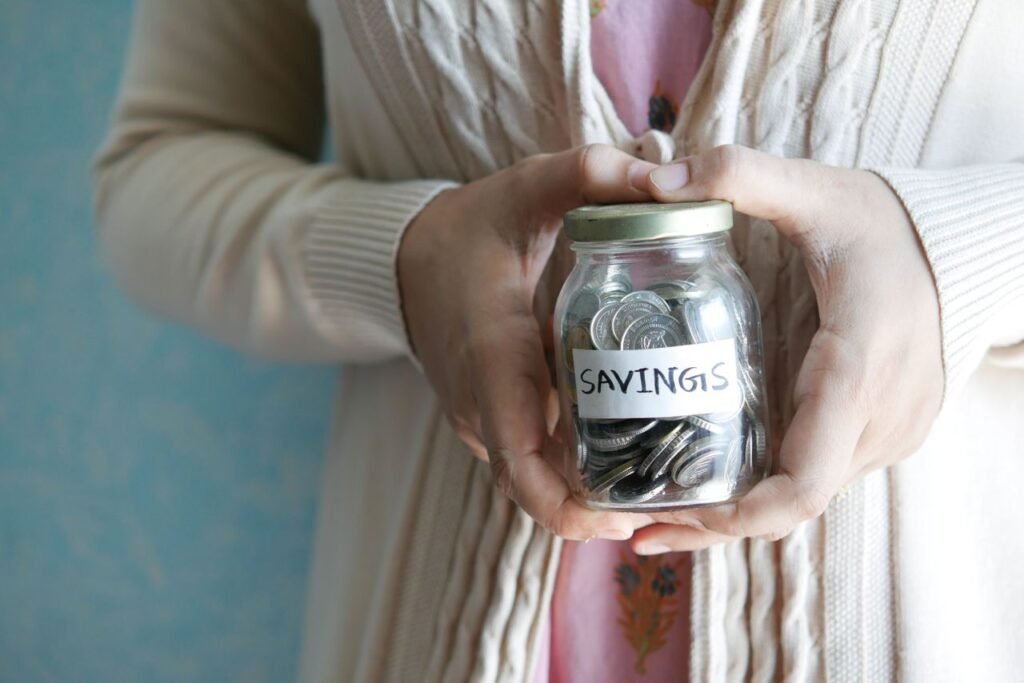
A high-yield savings account is an ordinary savings account that pays a much higher rate of interest than a typical savings account at a large branch bank. The money works the same way: you deposit it, it earns interest, and you can withdraw it when you need it. The difference is the rate, and it matters most for money you want to keep safe and within reach — an emergency fund, a deposit you are building, or savings for a holiday or a car — rather than money you are investing for decades. This guide explains how these accounts work, what to check before opening one, and where they fit alongside other ways of holding cash. It is educational only, not personal financial advice. No interest rate here is a guarantee: rates are variable, they change, and any rate you are offered should be checked on the bank’s own page on the day you open the account.
The basic idea
A savings account pays you interest for letting the bank use your money. A traditional savings account at a large bank often pays very little. A high-yield savings account pays considerably more, usually because the bank has lower costs. Online banks, which offer many of the best-known high-yield accounts, do not pay for thousands of branches, and they pass some of that saving on as a higher rate. The account is the same kind of product: your money sits in a deposit account, interest is added, usually monthly, and you can move money in and out. It is not an investment account. You are not buying shares, and the value of your deposit does not go up and down with the stock market. The return is the interest the bank pays.
Interest is usually quoted as APY — annual percentage yield — the rate your money earns over a year, including compound interest, which is interest earned on interest already added. A higher APY means more interest on the same balance over a year, if the rate stays the same. It rarely stays exactly the same, because these rates are variable. When the central bank moves its rates, savings rates tend to follow, usually with a lag. That is why a rate quoted in one month can be out of date the next, and why this article does not promise any particular rate.
How much more does it pay?
The gap between a typical savings account and a high-yield account is large. The US Federal Deposit Insurance Corporation (FDIC) publishes a national average savings rate, and as of 19 October 2026 that average was 0.38% APY. High-yield accounts checked in November 2026 were paying several times that average, with the best-known accounts clustered around 4% APY, though exact figures varied by bank, balance and conditions. The point is the scale of the difference: on $10,000, the national average rate would earn about $38 in a year if unchanged, while a rate around 4% would earn about $400. Those are illustrations, not promises.
Is your money safe?
In the United States, safety depends on deposit insurance. The FDIC insures deposits at member banks up to $250,000 per depositor, per insured bank, for each ownership category, backed by the full faith and credit of the US government. That limit applies to the combined balance of your accounts in the same ownership category at the same bank, including interest that has accrued. Before opening an account, check that the bank is FDIC-insured — the FDIC’s BankFind tool lets you search by bank name. Credit unions are covered by a parallel scheme, the National Credit Union Administration (NCUA), with the same $250,000 figure. Investment products are not insured, even when bought through a bank: shares, bonds, mutual funds and crypto assets sit outside deposit insurance.
Readers elsewhere have their own versions of the same protection. In the United Kingdom, the Financial Services Compensation Scheme (FSCS) protects deposits at UK-authorised banks, building societies and credit unions up to £120,000 per person, per banking licence, a limit that rose from £85,000 on 1 December 2025, according to the Bank of England. In Australia, deposits are protected under the Financial Claims Scheme, and in Canada the Canada Deposit Insurance Corporation (CDIC) insures eligible deposits — check the current limits on the regulator’s own site, because limits differ by country and can change. The principle is the same everywhere: protection applies to deposits at a regulated institution, up to a limit, and it does not cover investments.
What to check before you open one
The headline rate is only the first thing to check. The second is the conditions. Some accounts pay their best rate only if you meet a condition each month, such as a minimum deposit, a direct deposit, or a minimum balance. Some pay a higher rate for a short introductory period and then drop to a lower rate. Some pay different rates on different balances. Ask: what rate will I actually get, on my balance, with my habits, after any introductory period ends? The third thing is fees. Many high-yield accounts charge no monthly fee, but some charge if your balance falls below a threshold, or charge for services such as wire transfers. A fee can wipe out the benefit of a higher rate on a small balance.
The fourth is access: how quickly can you get your money out? Most high-yield accounts let you transfer money to a linked account, usually arriving the same day or the next working day, but transfers are not always instant. If the money is your emergency fund, same-day or next-day access is usually enough; if you might need cash within hours, a current account is the better home for that slice. The fifth is whether the account fits your purpose. A high-yield savings account is a good home for an emergency fund — most financial educators suggest three to six months of essential spending — and for short-term goals such as a deposit or a tax bill. It is a poor home for money you will not need for twenty years, because over long periods the return on cash is usually lower than the return on a diversified investment. For long-term money, learn how index funds work before deciding where it belongs.
High-yield savings vs other places to keep cash
A high-yield savings account is one of several places to keep cash, and the differences are about access, return and risk. A standard current account pays little or no interest, but gives instant access and a debit card. A money market account is similar to a high-yield savings account, often with a cheque book or debit card. A certificate of deposit, known in the UK as a fixed-rate bond, pays a set rate for a set term, and usually charges a penalty if you withdraw early. Government savings products, such as US Treasury bills, are backed by the government rather than by deposit insurance. None of these is “best” in the abstract. The right mix is usually a current account for day-to-day spending, a high-yield savings account for the emergency fund and short-term goals, and investments — held in a retirement account such as a 401(k) or an IRA — for money you will not need for many years.
Common mistakes to avoid
The most common mistake is chasing the highest headline rate without reading the conditions, then earning a much lower rate because a monthly deposit or balance condition was missed. The second is assuming the rate is fixed: it is variable, and it will change. The third is keeping far more than the insured limit in one bank, or assuming each account at the same bank gets its own limit, when the limit is per depositor, per bank, per ownership category. The fourth is keeping an emergency fund in an account that is hard to reach quickly, or in an investment that could fall just when you need the money. The fifth is leaving a large balance in a low-paying account for years out of habit. And the sixth is treating a high-yield savings account as an investment: it is a safe place for cash, not a way to build wealth over decades.
The bottom line
A high-yield savings account is a savings account that pays much more interest than a typical account, usually because the bank has lower costs. It is a deposit, not an investment, and in the US it is insured by the FDIC up to $250,000 per depositor, per bank, per ownership category. It is the right home for an emergency fund and for short-term goals, and the wrong home for money you will not need for decades. Before opening one, check the current rate on the bank’s own page, read the conditions, check the fees and the speed of access, and confirm the bank is insured. Rates are variable and will change; no rate in this article is a guarantee.
This article is educational only and is not personal financial or investment advice. Rates and protection limits change. Check the current rate, terms and insurance status on the provider’s own page before opening an account.