
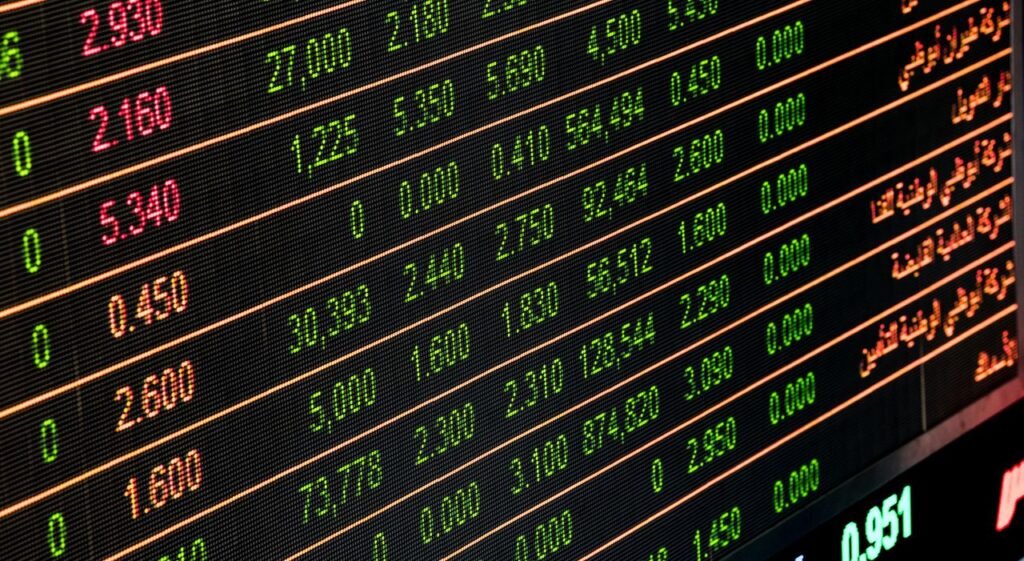
“The stock market was up today.” You hear the sentence on the news, at work, and in family conversations — but what does it actually mean? The stock market is not a single place. It is a system that lets companies raise money by selling small pieces of themselves, and lets people buy and sell those pieces. This guide explains, in plain English, what a share is, how exchanges work, what indexes measure, and how an ordinary beginner can understand the market without picking individual stocks. It is educational only, not investment advice, and it recommends no stock, fund or strategy. Prices can fall as well as rise, and you can get back less than you put in.
What a share actually is
A share, also called a stock or an equity, is a small piece of ownership in a company. When a company is divided into shares, each share represents the same fraction of the business: its factories, brands, cash, patents and future profits. If a company has one million shares and you own one, you own one-millionth of it. That is not a metaphor. Shareholders can vote on major decisions, such as electing the board of directors, and they hold the residual claim on the company — what is left after employees, suppliers, lenders and the tax authority have been paid belongs to them.
Shares today are almost entirely electronic records, not paper certificates. Your broker holds them for you in an account. A share also entitles you to a portion of any dividend the company chooses to pay from its profits. Not all companies pay dividends. Some reinvest all their profits in the business, hoping to grow faster, and shareholders benefit, if at all, from a rising share price instead.
Why companies sell shares
A company that wants to grow needs money. It can borrow from a bank, issue bonds, or sell ownership. Selling ownership means giving up a slice of the business in exchange for cash it does not have to repay. The first time a company sells shares to the public is called an initial public offering, or IPO. The money from the IPO goes to the company, to fund expansion or invest in new products. After that, the shares trade between investors on the secondary market. When you buy a share of a listed company, you are buying it from another investor who decided to sell — the company does not get a cut of that trade.
Exchanges: where trading happens
An exchange is a marketplace whose job is matching buyers with sellers. The two largest exchanges in the United States are the New York Stock Exchange (NYSE) and Nasdaq. The NYSE was established in 1792, and still combines electronic trading with a physical trading floor in New York. Nasdaq, founded in 1971, is fully electronic and is home to many technology companies. Other countries have their own exchanges, including London, Tokyo and Sydney.
Trading on the NYSE and Nasdaq runs from 9:30 am to 4:00 pm Eastern Time, Monday to Friday, excluding public holidays. Each exchange runs an order book: a continuously updated list of every offer to buy (bids) and every offer to sell (asks) for each stock, sorted by price and then by time. Price comes first — a higher bid beats a lower bid, a lower ask beats a higher ask — and then time, first come, first served at the same price. When a bid and an ask meet at the same price, a trade is made.
What moves a share price
A share price is the price of the most recent trade, and it moves because buyers and sellers change their minds about what a company is worth. Company results matter: profits, revenue, growth, debt and guidance about the future all feed into that judgement. So do interest rates, inflation, the wider economy, and news about the industry. Sentiment matters too — the mood of investors, which can swing faster than the facts. A share price is a snapshot of what people are willing to pay today, not a promise of what the company will be worth tomorrow. Over long periods, the value of a company’s shares tends to follow its ability to earn profits, but there is no guarantee, and no timetable.
Indexes: measuring the market
An index is a measuring stick: a basket of stocks, chosen by a set of rules, whose combined value summarises how part of the market is doing. You cannot buy an index directly, but funds can be built to track one. The three indexes you will hear most often in the United States are the S&P 500, the Dow Jones Industrial Average, and the Nasdaq Composite. The S&P 500 tracks about 500 of the largest US companies, and covers roughly 80% of the total value of the US stock market, which is why it is the default benchmark for “the market”. It is weighted by market capitalisation — the total value of a company’s shares, calculated as the share price multiplied by the number of shares outstanding — so larger companies move it more. The Dow Jones Industrial Average tracks just 30 large, well-known US companies. The Nasdaq Composite tracks most stocks listed on the Nasdaq exchange, and is heavily weighted towards technology. Other countries have their own headline indexes: the FTSE 100 in the UK, the ASX 200 in Australia, and the S&P/TSX Composite in Canada.
How ordinary people buy shares
You cannot walk into the NYSE and buy a share directly. You need a broker — a firm licensed to trade on your behalf — and an account with it. You deposit money, place an order, and the broker executes it on the exchange. Many brokers now offer fractional shares, which let you buy part of a share for a fixed amount of money. Read the fee schedule before you open an account, and check whether the broker is regulated in your country — in the US by the Securities and Exchange Commission (SEC) and the Financial Industry Regulatory Authority (FINRA), in the UK by the Financial Conduct Authority (FCA), and in Australia by the Australian Securities and Investments Commission (ASIC).
Most beginners do not start by picking individual shares. They start with a fund that owns many companies at once, such as an index fund or an exchange-traded fund (ETF). An index fund owns every company in an index, so one purchase gives you a small piece of hundreds of companies. An ETF is a fund that trades on an exchange like a share. Both are explained in our guides: What Is an ETF? and Index Funds Explained for Beginners. Diversification — owning many different companies, in different industries and countries — does not remove risk, but it does remove the risk that one company’s failure wipes you out.
Risk, and the beginner’s mindset
Shares are riskier than cash. Their prices fall, sometimes sharply, and there is no guarantee that they will recover, or when. Three ideas help beginners. First, time horizon: money you will need soon — for rent, a deposit, or an emergency — does not belong in shares, because prices can stay low for years. Second, diversification: a broad fund spreads your money across many companies, so no single failure decides your outcome. Third, costs and patience: fees compound, and frequent trading usually costs more than it earns. The US SEC’s investor education site, Investor.gov, publishes free plain-English guides on these ideas, and it is a good place to start.
Common mistakes to avoid
The most common mistake is treating the stock market as a way to get rich quickly, and buying a share because its price is rising or because someone online recommended it. The second is putting all your money into one company, or one industry. The third is checking prices every day and selling in a panic when the market falls. The fourth is confusing a good company with a good investment: a company can be excellent and its shares still overpriced. The fifth is investing money you will need soon, and being forced to sell at the worst moment. And the sixth is ignoring fees: a fund that charges 1% a year instead of 0.1% keeps far more of your return over decades than most people realise.
The bottom line
The stock market is a system for buying and selling small pieces of companies. A share is a piece of ownership. An exchange, such as the NYSE or Nasdaq, matches buyers with sellers. An index, such as the S&P 500, measures how a group of shares is doing. Prices move with company results, interest rates, the economy and investor sentiment, and they can fall as well as rise. For most beginners, the sensible starting point is not picking individual shares, but understanding the system, keeping short-term money in cash, and learning how diversified funds work before putting long-term money at risk.
This article is educational only and is not investment advice. It recommends no stock, fund or strategy. Investing involves risk, including the possible loss of principal.